
Quick Read
Residential and datacenter proxies differ mainly in where their IP addresses come from, how they perform, and how easily websites can detect them. This guide compares residential vs datacenter proxies across speed, cost, anonymity, ban risk, geo-targeting, and use cases. You’ll learn why residential proxies are better for tasks requiring authenticity and precise targeting, while datacenter proxies are faster and more budget-friendly. By the end, you’ll know which proxy type is better suited to your project.
Residential proxies use IP addresses assigned to real users by Internet Service Providers (ISPs). This makes you appear as a legitimate user on the internet.
Datacenter proxies obtain their IP addresses from data centers, rather than actual users. This is the key difference between the two.
The important point is that datacenter proxies are independent of ISPs, as their IPs are obtained from data centers rather than regular users’ devices.
Keep reading to learn more about the differences between residential and datacenter proxies.
Residential vs Datacenter Proxies: Detailed Comparison
Now that we’ve covered the basics of residential and datacenter proxies, it’s time to look at their differences. The following table provides a to-the-point comparison between these proxies.
| Factor | Residential Proxies | Datacenter Proxies |
| Type of IP Address | IPs assigned by ISPs to real users | IPs generated from data center servers |
| Speed | Average | Very fast |
| Pricing | Expensive | Budget-Friendly |
| Anonymity | High (IPs are obtained from real users) | Lower |
| Trust Level | High | Slightly lower |
| Legitimacy | Considered more authentic and legitimate | Appear less authentic (since IPs are not obtained from real users) |
| Ban Risk | IPs are less likely to be blocked | Higher risk of IPs getting blacklisted |
| Geo-Targeting | Very accurate/precise geo-targeting | Limited accuracy |
| Best For | -> Web Scraping -> Social Media Management -> Ad Verification | -> Market Research -> SEO Monitoring -> Bulk data scraping -> Automation tasks |
1. Type of IP Address
Residential proxies provide you with IP addresses assigned to real users. These IPs are assigned by Internet Service Providers (ISPs).
Datacenter proxies use IP addresses assigned to servers located in data centers. These IPs are not associated with ISPs, which makes them easier for websites to detect. So if you are looking for anonymity, datacenter proxies are not the best choice.
To summarize:
Residential proxies use IP addresses assigned by ISPs to real users, whereas datacenter proxies use IPs assigned to servers in data centers.
2. Speed
Datacenter proxies are well-known for their high speed. If you are looking to complete a task or project quickly, datacenter proxies are the obvious choice.
When it comes to residential proxies, their performance depends on real users’ network conditions. On average, their speed is slower compared to datacenter proxies.
However, it’s important to choose a reliable proxy service provider, such as Proxying, to ensure fast browsing speed.
Winner: Datacenter Proxy
3. Cost
Datacenter proxies are considered budget-friendly. They are produced in large quantities, and a proxy service provider can get you datacenter proxies at a lower cost.
On the other hand, residential proxies are more expensive, since they are obtained from real users. So, if you prefer a less expensive and faster proxy, datacenter proxies are the right choice.
Winner: Datacenter Proxy

4. Level of Anonymity
While achieving 100% anonymity is difficult, residential proxies provide a higher level of privacy when browsing online.
Since residential proxies come from devices of actual users, they use real IP addresses. And this means more privacy when surfing online.
Winner: Residential Proxy
5. Avoiding Ban
At this stage, it’s natural to ask: “Which proxy is best for avoiding online detection?” Here again, residential proxies are the clear answer.
If you choose datacenter proxies, you are more likely to get flagged or blacklisted. This is because the IP addresses provided are associated with data centers. Some of these IP ranges are already flagged as open proxies by the proxy detection systems.
On the other hand, residential proxies assign you an IP address linked to a real user’s device; they are far less likely to be detected. As a result, a residential proxy helps you avoid bans and bypass restrictions on various websites, including streaming platforms.
Winner: Residential Proxy
6. Geo-Targeting
If you want to target an audience in a specific region, it is useful to have an IP address from that exact city or location. Here again, residential proxies are the ideal choice.
Since residential proxies are linked to real homes in specific areas, the IP addresses you receive are more accurately associated with that region. This makes you appear online as if you are browsing from the target location.
As a result, you can deliver or advertise content to users in a specific region by appearing to be based there.
Winner: Residential Proxy
7. Ideal Use Cases
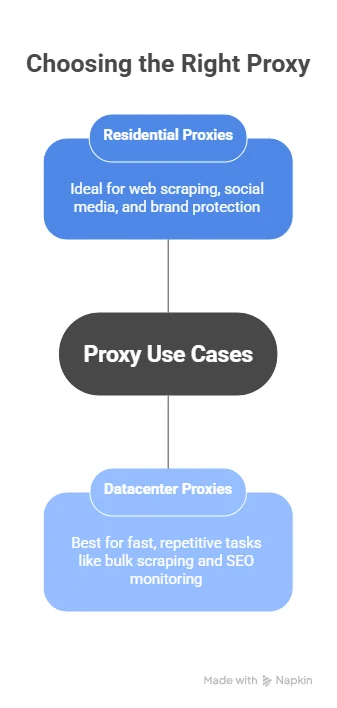
Both types of proxies are suited for different use cases. A residential proxy is ideal if your project involves tasks such as web scraping, social media management, and brand protection.
On the other hand, datacenter proxies are better suited for fast, repetitive tasks such as bulk data scraping and automating manual processes
Conclusion
The residential vs datacenter proxies question is hard to answer, and the final choice depends on your project needs and budget.
What’s not in doubt is that you need a reliable and powerful proxy service, such as Proxying. Sign up today and choose your preferred proxy at affordable rates.