
The results from Google searches may vary from location to location. The website that ranks first in the U.S. for a certain keyword may be ranked lower in France or Germany.
Manual review of hundreds of keywords in various markets is not feasible for any SEO team. Here we compare five different proxy providers: Proxying, Oxylabs, Decodo, Scraper API, and Webshare. You will understand their respective benefits and which one is suitable for your SEO monitoring needs.
Our Selection Methodology: How We Selected Each Proxy Provider
Selecting the best proxies for SERP analysis is more than just looking at the size of the IP pool. You need a provider that supports your desired positions, collaborates with your SEO tools, and doesn’t force you to work hard on your monitoring.
The following five criteria were used to compare the five providers:
- The quality of IP’s: The companies’ offering of residential, ISP, or datacenter IP’s appropriate for SERP monitoring.
- Location targeting: If you can view Google results from a particular country and, where available, a city.
- Rotation and sessions: Ability to rotate IP addresses or to have a consistent connection when necessary.
- Scalability: Whether frequent keyword checks and large monitoring projects are possible.
- Integration: Compatibility with tools and scripts for SEO or workflows that automatically gather data.
- Pricing: Reasonable value for the expected traffic and usage of your website.
- Ease of use: The amount of setup and proxy management required by the service.
Best SEO Proxies: Pricing and Feature Comparison
| Provider | Proxy Types / Solution | Starting Price | Free Trial / Free Access | Best For | Main Advantage |
|---|---|---|---|---|---|
| Proxying | Residential, ISP | Residential: $3/GB; ISP: $2.25/IP | Free MBs through Discord and Telegram communities | SEO agencies and custom SERP monitoring | Affordable entry and flexible connection options |
| Oxylabs | Residential proxies, SERP scraping solutions | Residential: $6/GB on the starter plan | $5 welcome credit; additional trials depend on eligibility | Enterprise SEO teams | Large-scale data collection |
| Decodo | Residential, ISP, mobile, datacenter, scraping tools | Residential: $3.75/GB on the entry monthly plan | 100 MB for 3 days, subject to trial conditions | Growing SEO teams | Multiple proxy types and data collection options |
| ScraperAPI | Web scraping API and SERP collection solutions | $49/month for the Hobby plan | 7-day trial with 5,000 API credits; free plan also available | Developers and automated monitoring | Simplifies scraping without manual proxy management |
| Webshare | Datacenter, static residential, rotating residential | Datacenter: $2.99/month for 100 proxies; residential pricing varies by plan | 10 free datacenter proxies, with up to 1 GB/month | Freelancers and smaller agencies | Flexible plans and a free starting option |
Note: These providers charge in various ways. The cost of residential proxies can vary depending on how much data they consume; ISP and Datacenter proxies can come with a per-IP fee, and scraping APIs can cost by subscription or usage credits. Look at the overall price for the amount of work you are expecting, not just the initial price.
1. Proxying
If you are an SEO professional who requires residential and ISP proxies for Google SERP analysis, competitor research, location-specific ranking checks, etc., Proxying is the best thing to use.
Residential proxies enable you to analyze search results by geographical region. An SEO agency for the US, France, and Germany can, for instance, work on the connections of each area to compare the ranks of keywords in each country.
The Proxies support both HTTP and SOCKS5 connections, meaning that they can be used with compatible SEO tools and scripts. They can be used to create a custom monitoring workflow, to gather search data, and to analyze the changes in ranking over time.
Pros
- Residential proxies vs ISP proxies: Decide which type of proxy you need for your SERP monitoring needs.
- Check search visibility on supported geographic locations: Location-based research.
- Easily integrate: Compatible proxies, custom scripts, and SEO tools.
- Several protocols: HTTP and SOCKS5 support different kinds of applications.
- Own workflows: Control your own request processing and measurement process.
Cons
Needs configuration: Proxy rotation, sessions, request handling, etc may need to be configured.
Ideal for: SEO experts, agencies, and developers who wish to have the autonomy to configure their proxy for geographic ranking verifications and automated SERP monitoring.
2. Decodo
Best for: SEO agencies tracking rankings across multiple locations
Decodo, which was previously called Smartproxy, has residential, ISP, datacenter, and mobile proxies. These proxies can be used by SEO experts to track keyword rankings, analyze competitors, and compare search results in various markets.
If a client’s ranking in Paris differs from the ranking in Berlin, for instance, then an agency monitoring the client’s ranking in these cities must verify how Google results are displayed in both places. Decodo’s geographic targeting capabilities can help in this research. Also, the way it rotates residential proxies comes in handy for workflows that require a lot of requests.
Key Features
- Various proxy types: Select from mobile, datacenter, ISP, and residential proxies.
- Target Countries/Cities: Choose the countries and cities that they support for local SEO.
- IP rotation: Use multiple IPs to repeatedly check SERPs and collect data.
- Consistent IP address: Supported session settings for workflows that need a consistent IP address.
- SEO tool compatibility: Set up proxies for specific SEO tools and scripts.
Pros
- Provides multiple proxy types supporting multiple different SEO tasks.
- Enables geographic targeting of international campaigns.
- Facilitates connection and flow of sessions.
- Best for agencies tracking multiple market rankings.
Cons
- The more data you use, the more expensive it gets in terms of the price of residential proxies.
- The available locations and the features of the session depend on the type of proxy that is selected.
- It might be necessary to trial various combinations to work out what works best with your tools for SEO.
Verdict: Verdict is a good choice for SEO agencies that require geographic targeting and various proxy types.
3. Bright Data
Best for: Enterprise SEO campaigns and large-scale SERP data collection
Bright Data provides businesses with residential, ISP, datacenter, and mobile proxies that can be used to gather data from various markets. It has a proxy network that allows you to track your keywords, study your competitors, and benchmark search results by country.
Key Features
- Various proxy types: Residential, ISP, datacenter, mobile.
- Geographic targeting: Access supported locations for local SERP analysis and international SEO research.
- IP rotation and session control: Set up connections to control and rotate IPs and sessions for workflows that require it.
- Create large-scale data collection: The proxy infrastructure can be applied for ongoing research and high-volume SEO operations.
- Business-oriented tools: Learn about other data collection options for more advanced research processes.
Pros
- Provides a wide variety of different proxies for various SEO purposes.
- Enables location-based research in international markets.
- Offers options for campaigns that have significant data collection needs.
- Supports more advanced workflows with more than just proxy connections.
Cons
- It has a large selection of products, which can make it more difficult to set up for new users.
- This might also be on the expensive side for smaller websites or straightforward rank-tracking efforts.
- The price is different for different products and varies according to usage, so check the total cost before buying.
Verdict: Bright Data is good for enterprise SEO teams that require a lot of geographic coverage and tools for collecting large-scale data.
4. DataImpulse
Ideal for: Affordable SEO campaigns and adaptable data gathering.
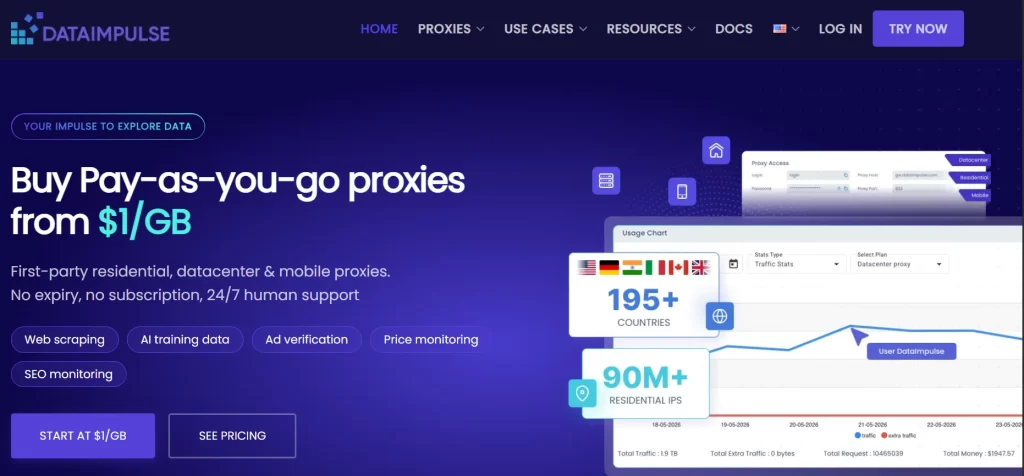
DataImpulse provides residential and data center services for SEO experts who want to gather data on search without investing in a pricey system. Its services can assist you in competitor research, local search checks, and ongoing data collection across markets.
Key Features
- Residential connections: For location-specific research, use the residential IP addresses.
- Datacenter connections: For tasks where speed and cost are critical, consider datacenter connections.
- Geographic coverage: See what locations are available for target markets.
- Data pricing: Charge based on the amount of data you are expected to use.
- Flexible usage: Fine-tune your needs based on your SEO initiatives’ expansion.
Pros
- Provides alternative ways to collect data depending on the type of data.
- Teams can control costs with traffic-based pricing.
- Assists with competitor research and area search engine optimization tests.
- Can support continuous campaigns that grow in size.
Cons
- Price may be a bit expensive if you are collecting huge amounts of data.
- The available locations and targeting features are dependent on the product.
- Before scaling, try out your performance on your own SEO tools.
Verdict: If you’re an SEO team that values usage-based pricing and is looking to increase data collection as your budget allows, then DataImpulse is worth considering.
5. Webshare
Best for: Small SEO projects and affordable data collection
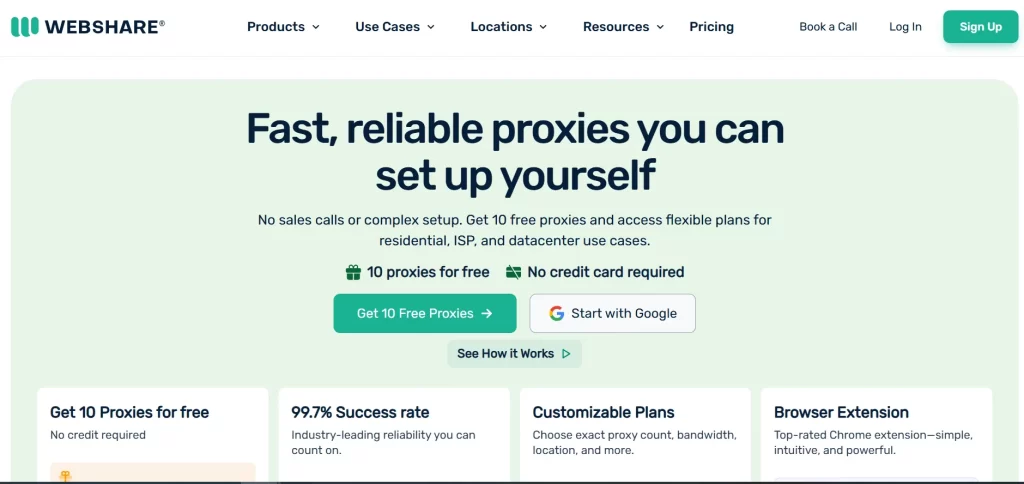
Webshare has a data center, static residential, and residential product for every budget and data collection requirement. It can be a useful option for freelancers and small SEO teams who have to monitor search results, research competitors, and track keyword rankings.
Key Features
- Datacenter options: Appropriate for tasks in which speed and cost are important.
- Residential options: For supported location-based research, use residential IPs.
- Static residential options: Keep an IP address for workflows that need stable connections.
- Flexible plans: Review the options offered in terms of pricing against your usage.
- Tool compatibility: Set up connections with compatible SEO software and custom scripts.
Pros
- Provides alternatives to various budgets and SEO workloads.
- Periodic data collection can be on a cost-effective datacenter plan.
- Offers options to rotate and more stable IP connections.
- Can handle freelancers and smaller teams who have simple needs.
Cons
- Datacenter connections might not be appropriate for jobs that particularly require residential IPs.
- Geographic targeting is available only with certain types of connections and plans.
- You may need to experiment with different configurations to achieve the desired cost and performance.
Verdict: Webshare is a viable choice for freelancers or small SEO teams that require flexible plans and an entry-level solution.
6. SOAX
Best for: Location-specific SEO research and international rank tracking
For businesses that gather web data from various locations, SOAX provides solutions for residential, mobile, ISP, and data center deployments. For those doing search engine optimization and wanting to compare search results across countries and cities, its geographic targeting options may be a viable option.
Key Features
- A variety of connections: Residential, Mobile, ISP, Data Center.
- Geo-targeting: Choose supported locations to target in local search research.
- IP rotation: Rotate IPs for multiple data collection efforts.
- Session control: Try out the various session control settings for a consistent IP in your workflow.
- Integration options: Set up integration with other SEO tools and scripts.
Pros
- Provides multiple connection options for various types of SEO work.
- Geographic targeting, which aids international search marketing, is included.
- Various options for rotation and sessions.
- Ideal for agencies tracking market rankings from different markets.
Cons
- The more data that is collected, the more it will cost.
- Services vary by plan, and the location is available.
- Newbies may require time to set up the service with their SEO tools.
Verdict: SOAX is a good choice for SEO teams with a focus on geographical targeting and location-based search research.
7. NetNut
Best for: Ideal use case: Large-scale SEO campaigns or data collection for repetitive projects.Best suited for: Large SEO campaigns or repetitive data collection projects.

NetNut provides business solutions for residential and ISP-level data collection of Web data at scale. It’s a network that SEO teams can leverage to conduct competitor analysis, keyword research, SERP monitoring, and check international search visibility.
Key Features
- Local search research and competitor monitoring: Do it with residential IP addresses.
- ISP connections: These can be used for workflows that demand more stable IP addresses.
- Geographic coverage: Test for international SEO campaigns.
- Integration options: Set up supported connections to compatible SEO tools and custom scripts.
Pros
- Provides residential and ISP solutions for various kinds of SEO workloads.
- Can facilitate ongoing research in several target markets.
- Supplies alternatives for businesses that have to gather more data.
- It is ideal for teams testing for more consistent connections, as well as residential IP access.
Cons
- In some cases, its services could be too much for a freelancer to deal with when tracking basic ranks.
- Cost and requirements should be verified prior to commitment.
- You need to check location coverage and compatibility with your SEO tools.
Is it Legal to Use SEO Proxies?
Using SEO proxies is not automatically illegal. Legality depends on how you use them, what data you collect, and the laws that apply. Proxies can help with location-based SEO research, but they do not override website terms or platform policies.
Before collecting data, review the target website’s rules, respect applicable privacy laws, and avoid excessive requests. Google also prohibits automated search queries for rank checking without express permission under its spam policies.
The key takeaway: Use SEO proxies responsibly and ensure your data collection follows applicable laws and platform rules.