
Quick Read
An ISP proxy, also called a static residential proxy, uses an IP address registered to a real Internet Service Provider (ISP) while running on high speed datacenter infrastructure. It offers the speed and reliability of datacenter proxies with an IP that appears residential to most websites. ISP proxies are ideal for web scraping, ad verification, account management, and price monitoring on sites with basic to moderate anti bot protection.
What Is an ISP Proxy?
An ISP proxy is a hybrid proxy that uses IP addresses assigned by real Internet Service Providers, the same companies that provide internet connections to homes and businesses. Think AT&T, Spectrum, Comcast, or Xfinity.
What makes ISP proxies different from other proxy types is the combination: the IP address is registered under a real ISP’s name, but the proxy itself runs on a datacenter server. This gives you two things at once: the legitimacy of a residential IP and the speed and stability of datacenter infrastructure.
Why does this matter? Because websites don’t just look at your request. They also evaluate where it comes from. One of the first things they check is the reputation of your IP address.
Datacenter IPs register as coming from hosting companies, an immediate signal that automated traffic may be involved. Residential IPs register as coming from consumer ISPs, making the traffic appear more like a real user.
To most websites, an AT&T IP still appears to be an AT&T IP, whether the traffic comes from a home connection or a provider’s datacenter server. That makes ISP proxies much more convincing than traditional datacenter proxies, although advanced anti-bot systems can still identify them using other signals.
You will also hear ISP proxies referred to as static residential proxies. This refers to the same thing: the IP is residential in origin and static in behavior, meaning it stays fixed across a session rather than rotating on every request.
New to proxies entirely? Read our “ What is a proxy” guide.
How ISP Proxies Work
The reason ISP proxies work comes down to how websites identify where internet traffic originates. One of the signals they use is the Autonomous System Number (ASN), which identifies the organization that owns a block of IP addresses.
Every IP address is associated with an ASN. A home internet connection traces back to your ISP’s ASN, while a datacenter proxy traces back to a hosting provider like Amazon AWS or DigitalOcean. Because hosting providers are commonly used for automated traffic, their ASNs are much more likely to be flagged by anti-bot systems.
ISP proxy providers purchase IP allocations directly from ISPs. These IPs are registered under the ISP’s ASN – the same ASN that covers real residential customers. The proxy provider then hosts these IPs on their own datacenter servers. The IP looks residential. The infrastructure is datacenter. The result is a proxy that passes most basic legitimacy checks at datacenter speed.
Here is the request flow step by step:
- Your device sends a request to the ISP proxy server.
- The proxy server forwards that request using the ISP-registered IP address, not a datacenter IP.
- The target website’s server sees the request arriving from what appears to be a residential user on a consumer ISP.
- The website responds to that IP, and the proxy server forwards the response back to you.
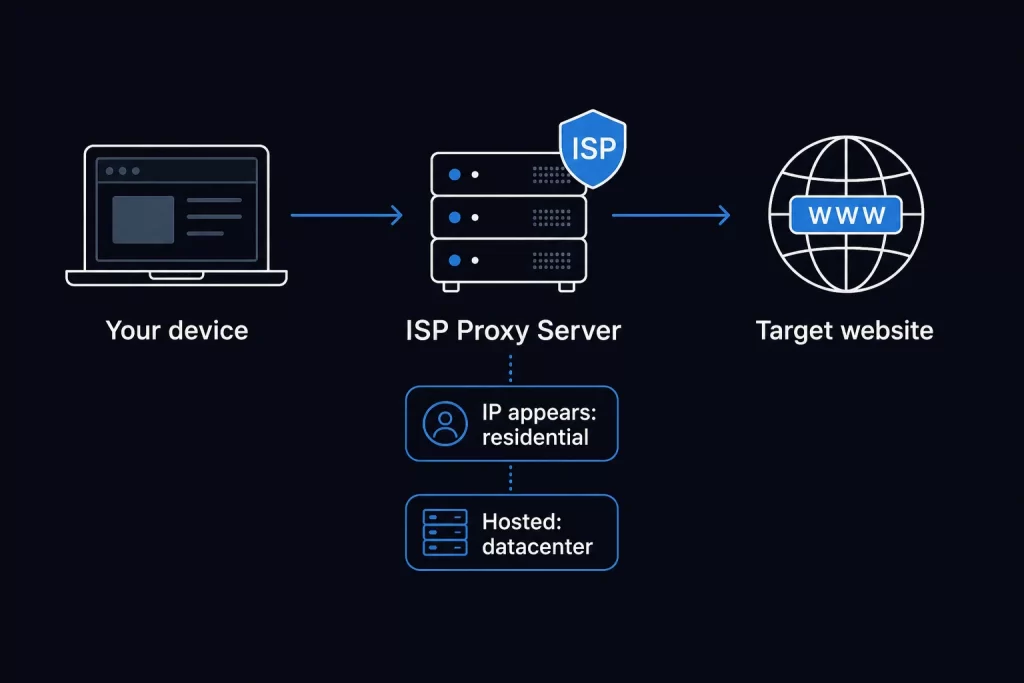
The important nuance: this process makes ISP proxies effective against basic to moderate anti-bot systems that rely on IP reputation and ASN checks. Advanced systems that analyze browser behavior, TLS fingerprints, and connection patterns can still identify the datacenter origin. More on that in the disadvantages section below.
ISP Proxy vs Residential Proxy vs Datacenter Proxy
Understanding ISP proxies is easier when you see all three types side by side. Each type trades off speed, legitimacy, IP pool size, and cost differently.
| Datacenter Proxy | ISP Proxy | Residential Proxy | |
|---|---|---|---|
| IP source | Hosting companies | ISP-registered, datacenter-hosted | Real home devices |
| Speed | Very high (1 Gbps+) | Very high (1 Gbps+) | Moderate (device-dependent) |
| Uptime | 99.9%+ | 99.5%+ | Variable |
| Legitimacy | Low – easily detected | Medium-high – appears residential | Highest – real home IPs |
| IP pool size | Large | Small to medium | Very large (millions) |
| Session type | Rotating or static | Static (fixed IP) | Rotating or static |
| Detection risk | High | Low to moderate | Very low |
| Cost | Lowest | Medium | Highest |
| Best for | Speed-sensitive, low-security targets | Moderate-security + speed needed | High-security scraping, max anonymity |
Residential proxies
Residential proxies route your traffic through real devices – actual phones, laptops, and home routers belonging to real people. The IPs are the hardest to block because they behave exactly like normal residential traffic. The trade-off: speed is limited by the real device’s connection, and costs scale quickly for high-volume use.
Datacenter proxies
Datacenter proxies are the fastest and cheapest option. The IPs come from hosting providers and are immediately recognizable as datacenter traffic by any competent anti-bot system. Best suited for targets that don’t care where your IP comes from, or where raw speed and cost matter more than IP legitimacy.
ISP proxies (the middle ground)
ISP proxies sit between the two. You get speed that matches datacenter proxies, legitimacy that comes close to residential, and costs that are significantly lower than large residential pools. Proxying is one option here, alongside a handful of other providers. The limitation shared across all of them is a smaller IP pool and vulnerability to subnet blocking.
For a deeper breakdown, see ISP vs residential proxies and ISP vs datacenter proxies.
ISP Proxy Use Cases
ISP proxies are versatile. Here are the scenarios where they earn their place.
Web scraping
Web scraping is the most common use case. ISP proxies work well for scraping e-commerce sites, product catalogs, travel pricing, and real estate listings where the target site has basic anti-scraping in place.
The stable single IP from a known ISP appears as a returning visitor, not a bot farm. Most mid-tier e-commerce platforms block by request frequency or datacenter IP range, both of which ISP proxies avoid.
One Practical Note: if you are making a very high volume of requests from a single static ISP IP, even a residential-looking IP can attract attention. At high request volumes, rotating residential proxies combined with IP rotation strategies becomes more appropriate. For automated scraping pipelines that run continuously, plan your rotation strategy before committing to static ISP IPs at scale.
Ad verification
Ad verification is one of the strongest fits for ISP proxies. The task is to verify that your ads (or competitors’ ads) are appearing correctly in specific regions for real users. You need a stable IP that looks like a real home user in a real location – exactly what ISP proxies deliver.
Because the IP is fixed, you can return to the same “location” repeatedly and get consistent results. Datacenter proxies often get served bot-trap creatives rather than real ad inventory. ISP proxies avoid that.
Account management and multi-accounting
Managing multiple accounts on social platforms, marketplaces, or other services benefits directly from ISP proxies. A static IP registered to a real ISP in a specific region (say, a Texas-based AT&T IP for a Texas-based account) looks like a normal user accessing their account from home.
The fixed IP also prevents the account from being flagged for accessing from constantly changing IP addresses, which is a common trigger on platforms like eBay, Amazon seller accounts, and social networks.
Price monitoring and market intelligence
Tracking competitor pricing, product availability, and regional pricing differences is a natural fit. Price monitoring scripts need to run repeatedly over days and weeks without triggering blocks. A stable ISP proxy that looks like a consistent home user avoids the detection patterns that frequent IP rotation can trigger on some e-commerce sites.
Brand protection and marketplace monitoring
ISP proxies let you monitor marketplaces for counterfeit products, unauthorized sellers, and trademark violations while appearing as a normal shopper. Consistent identity across monitoring sessions means you can track changes over time without each visit looking like a new entity – which matters when analyzing whether a specific unauthorized listing changes or persists.
Ticket purchasing and limited drops
For time-sensitive purchases (concert tickets, sneaker releases, limited products), ISP proxies offer speed without the latency penalty of residential proxies. Most ticket platforms target obvious bot patterns and rotating residential pools. A single high-speed ISP IP with realistic browsing behavior can be harder to catch. That said, this is a constantly evolving cat-and-mouse game, and results vary by platform.
ISP Proxy Advantages
Datacenter-grade speed. ISP proxy IPs run on datacenter servers with 1 Gbps+ connections, sub-10ms latency, and 99.5%+ uptime. You get the speed of a datacenter proxy without the legitimacy problem.
Residential-looking IPs. The ISP-registered ASN means most IP reputation checks pass. Websites that block datacenter ranges won’t automatically block an AT&T or Spectrum IP.
Stable, long sessions. Because the IP is static, you can maintain the same identity across a session that lasts hours or days. This is critical for account management, long-running scrapes, and any task where session continuity matters.
Better anonymity than a datacenter. ISP proxies are significantly harder to identify as proxy traffic than datacenter IPs, which are flagged aggressively by most anti-bot systems.
Lower cost than residential at scale. For moderate-volume tasks that don’t require millions of IPs, ISP proxies are a cost-effective alternative to large rotating residential pools.
High bandwidth. Unlike residential proxies, which depend on the available bandwidth of a real person’s home connection, ISP proxies have no practical bandwidth ceiling.
ISP Proxy Disadvantages
Subnet blocking risk. This is the most significant limitation. ISP IPs are grouped in subnets (a typical /24 subnet covers 256 IPs). If one IP in the subnet gets flagged or blocked by a target site, neighboring IPs face elevated risk. A single incident can effectively burn an entire subnet for a given target. Recovery requires switching to IPs from a different subnet, which often means using a different provider.
Small IP pool. Acquiring IP allocations directly from ISPs at scale is hard. Most ISP proxy providers have a pool ranging from a few hundred to a few thousand IPs, compared to the millions available in residential proxy networks. Geographic diversity is limited, and you may find limited availability in specific regions.
Detectable by advanced anti-bot systems. ISP registration passes basic IP checks, but systems like DataDome, Cloudflare’s Bot Management, and Imperva go deeper. They analyze connection behavior, TLS fingerprints, browser signals, and request patterns. A datacenter-grade connection that never varies like a real human browsing session can still be identified, even if the IP looks residential on the surface.
Less anonymity than rotating residential. Advanced investigation can trace an ISP proxy IP back to its datacenter provider. If the provider’s infrastructure is identified, all their IPs become suspect.
More expensive than datacenter. ISP proxies typically cost $1 to $3 per IP per month, depending on the provider. Datacenter proxies can start well below $1 per IP. If your target site doesn’t use sophisticated IP reputation checks, the legitimacy premium may not be worth the cost.
ISP Proxies vs Rotating Residential: How to Choose
This is the question practitioners ask most often. The short answer: ISP proxies win on speed and stability; rotating residential proxies win on legitimacy and IP diversity.
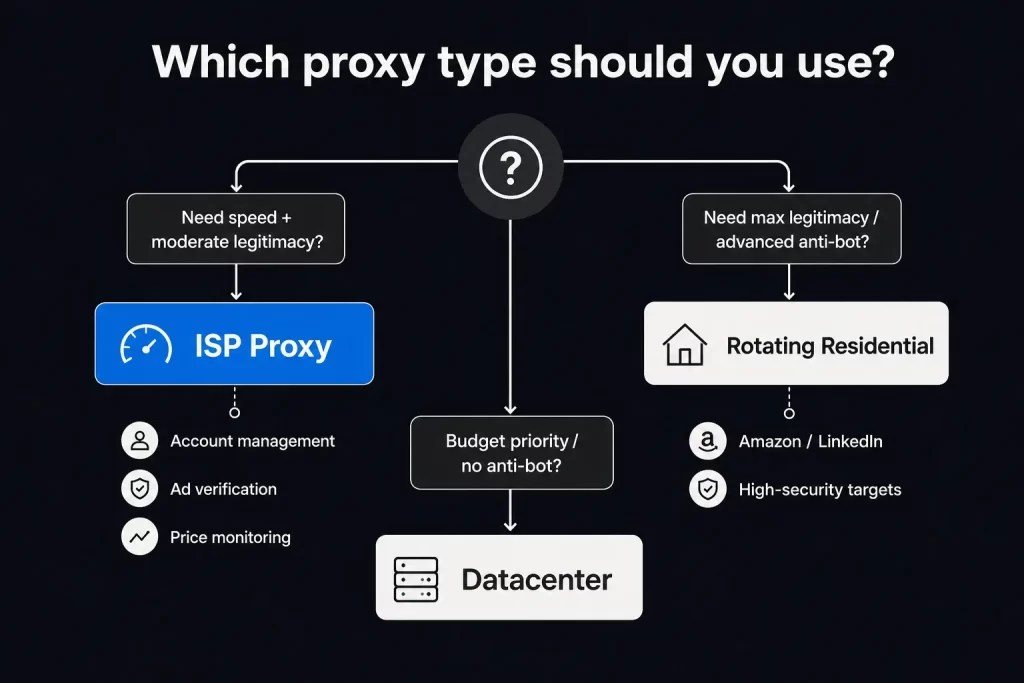
Choose ISP proxies when:
- You need fast, stable connections, and your target site has basic to moderate anti-bot protection.
- You need consistent identity over long sessions (account management, ad verification, long-running monitors).
- You are scraping mid-tier e-commerce, real estate, travel pricing, or similar sites that block datacenter IPs but not ISP-registered residential IPs.
- Budget matters, and your volume doesn’t require millions of IPs.
Choose rotating residential proxies when:
- Your target site uses advanced anti-bot technology (Amazon, LinkedIn, banking platforms, and ticketing sites with sophisticated protection).
- You need high IP diversity to distribute requests across many unique addresses.
- Anonymity is the top priority, and you can absorb the speed and cost trade-off.
- You are running large-scale scraping where a single blocked subnet would be catastrophic.
Choose datacenter proxies when:
- Your target site doesn’t use IP reputation checks (internal tools, simple APIs, targets that don’t care about proxy traffic).
- You need maximum throughput at minimum cost.
- Raw speed and scale matter more than legitimacy.
In practice, many teams run ISP proxies as their primary tool and keep a rotating residential proxy pool for the high-security targets they encounter. The combination covers most scenarios without overpaying for everything.