
You were there at the checkout. You had the right bot, the right timing, everything lined up.
Inventory: gone. Before you could even hit add-to-cart.
That’s Pokémon Center in 2026.
The Prismatic Evolutions restock, the Destined Rivals pre-orders, the Pokémon 30th Anniversary sets. Every single one cleared in under 30 seconds. Not because the stock was shallow. Because thousands of botters were already there, throwing simultaneous requests at the same checkout page while you were still opening your browser.
This isn’t about fair. This is about what actually works.
We tested and compared 10 proxy providers against the criteria that actually determine if you’ll hit checkout or get blocked before the page loads: residential and ISP proxy reliability, latency, rotation behavior, geographic reach, and what you actually pay. Here’s the breakdown.
What Makes a Proxy Good for Pokémon Card Botting
This is where the theory meets reality. Generic proxy marketing is not written for drops. Here’s what actually matters.
ISP proxies over Datacenter. Pokémon Center blocks datacenter subnets. Full stop. An ISP proxy lives on a real ISP’s network – the same one consumers use – and you can’t block it without blocking real customers too. Datacenter = 403. ISP = queue.
Residential for scale. Running 50 simultaneous checkout threads? Residential proxies rotate across millions of household IPs. Each request looks like it came from a different person. That’s how you avoid per-IP flagging when you’re throwing volume at them.
Session stickiness is not optional. Pokémon Center checkout takes multiple requests. Your proxy rotates the IP mid-checkout, your session breaks, your order fails. You need to hold the same IP for at least 10-30 minutes without rotation.
Latency kills you at drops. The window between page load and inventory zero is under 5 seconds. A 1-second proxy latency is the difference between a successful add-to-cart and getting nothing. Tier-1 ISP proxies run under 0.5 seconds. Residential runs 0.5-1.5 seconds. Know the difference.
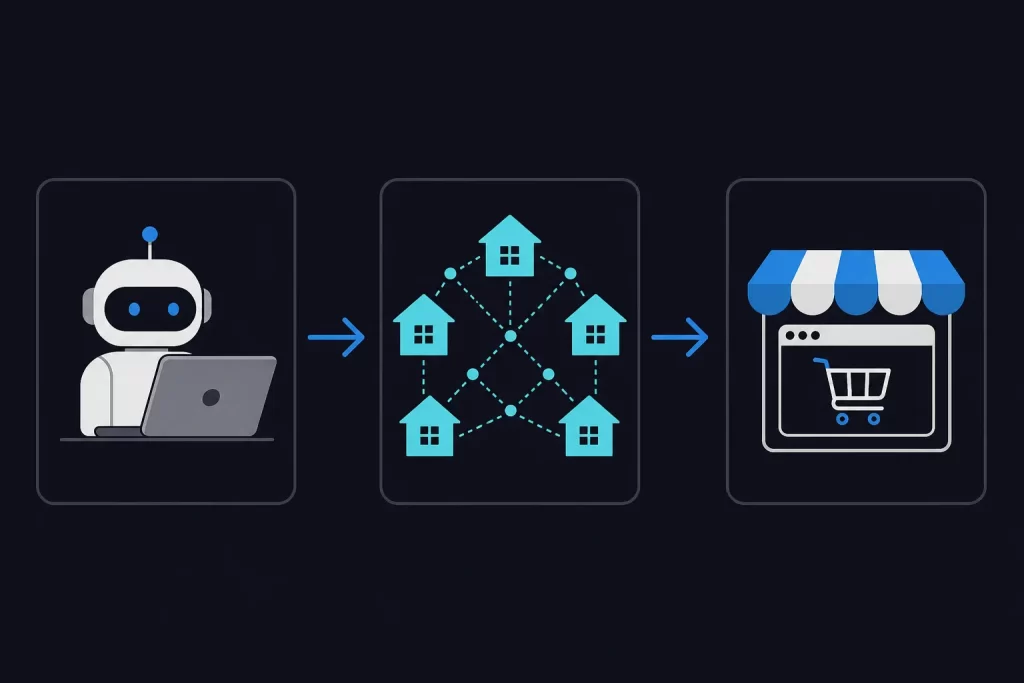
The 10 Best Proxies for Pokémon Card Botting
Quick Comparison
| Provider | Type | Best for | Starting price |
|---|---|---|---|
| Proxying | Residential + ISP | Best overall | $1.50/GB / $2/IP |
| Decodo (Smartproxy) | Residential + ISP | Speed + value | $2/GB / $0.27/IP |
| Bright Data | Residential + ISP | Large-scale ops | $4/GB / $1.30/IP |
| Oxylabs | Residential + ISP | Premium reliability | $6/GB / $16/mo |
| IPRoyal | Residential + ISP | Mid-budget | $5.25/GB / $1.80/IP |
| SOAX | Residential | Volume scraping | $200/mo min |
| Rayobyte | Residential + ISP | US-heavy botting | $3.50/GB / $4.60/IP |
| Proxy-Cheap | Residential | Budget entry | $0.78/GB |
| Webshare | Residential + ISP | Free tier + scale | $3.50/mo |
| Shifter | Residential + ISP | Established network | $0.75/GB / $1/IP |
1. Proxying
Proxying.io is the one. ISP proxies on real Tier-1 ASNs (AT&T, Comcast, the ones that matter), residential rates that don’t gouge, and no minimum spend. That’s it. That’s the move.
The residential pool is 10M+ IPs, 195+ countries, 99%+ success. The ISP tier hits 99.9% – the number that actually counts on checkout flow. HTTP, HTTPS, SOCKS5 with UDP. All of it.
Here’s what you actually use: ISP proxies for the primary account checkout. Rotating residential as fallback for the monitoring threads hitting the same product page from different angles. The pricing lets you do both – pay per GB as you use it, data never expires, so you can buy before the drop and it sits there until you need it.
Proxying has a practical guide on reducing proxy bans during Pokémon Center drops that’s worth reading alongside this post.
Pros:
- ISP proxies on real Tier-1 ASNs – lowest detection risk for Pokémon Center
- Residential from $1.50/GB (introductory), $2/IP for ISP with unlimited bandwidth
- 100MB free on joining their Discord or Telegram community, no credit card required
- Pay-as-you-go, no subscriptions, data never expires
- HTTP, HTTPS, SOCKS5 + UDP support
- 195+ country coverage with rotating and sticky session options
Cons:
- Smaller residential pool (10M+) compared to enterprise providers like Bright Data
- Fewer community reviews than long-established competitors
| Plan | Price | Notes |
|---|---|---|
| Residential (intro) | $1.50/GB | Regular price $3.00/GB |
| ISP Proxy | $2.00/IP | Unlimited bandwidth |
| Free MBs | 100 MB | Join Discord or Telegram community |
Our take: The best option on this list. ISP quality on real ASNs, no-expiry billing, flexible pricing, and 100MB free to test before you commit.
2. Decodo (formerly Smartproxy)
Decodo is an option some botters use. The 115M+ residential pool is massive enough that you won’t burn through usable IP ranges even at scale. The ISP tier at under $0.27/IP on committed plans is the second-best pricing for static IPs anywhere.
0.2-second latency on ISP proxies. That’s the speed where proxy speed stops mattering and everything else does. The 99.92% success rate on 125M+ IPs is the actual number, not a marketing round-up. City and ZIP-level US targeting means you can hit region-specific Pokémon drops without wasting requests on non-shipping zones.
One thing: Decodo rebranded from Smartproxy in 2025 and now leads with AI scraping APIs and data platforms. The proxy products didn’t change – same infrastructure, same IPs, same speeds. It’s still the same proxy service, just wrapped in different marketing now.
Pros:
- 115M+ residential IPs, 0.5s average response time
- ISP proxies from $0.27/IP (committed plans), 0.2s response time
- 99.92% success rate on residential
- City, state, ZIP, and ASN-level geo-targeting
- Sticky sessions available for multi-step checkout
Cons:
- Entry-level residential ($2–$3.75/GB) is pricier than budget options
- Rebrand to Decodo means some documentation is still catching up
- Enterprise ISP pricing requires committing to a plan
| Plan | Price |
|---|---|
| Residential | $2.00–$3.75/GB |
| ISP Proxy (starter) | from $0.27/IP (committed plan) |
| Free trial | No |
Our take: Speed is solid, but the best ISP pricing requires locking into a committed plan and there’s no no-expiry billing or pay-as-you-go flexibility.
3. Bright Data
Bright Data owns the largest network on the planet. 400M+ residential IPs, 195 countries, 5.5 trillion HTTPS requests a year. You will not run out of fresh IPs. Ever. Scale doesn’t matter.
At serious volume, the ISP tier is 1.3M + static IPs at $1.30/IP for the 1,000-IP tier. Competitive pricing for enterprise. 99.95% success, 99.99% uptime SLA.
The catch: Bright Data monitors active compliance. They watch for ToS violations and will kill accounts running blatant botting on platforms that forbid it. For serious, non-skeezy operations, it’s fine. For full-throttle aggressive botting, you’re taking a risk. The residential pricing at $4-8/GB is also expensive; entry is only justified if scale makes the cost irrelevant and the 50% first-month promo actually saves money.
Pros:
- World’s largest residential network: 400M+ IPs
- 1.3M+ ISP proxies, $1.30/IP starting price
- 99.95% success rate, 99.99% uptime SLA
- 20,000+ enterprise customers
Cons:
- $4–$8/GB residential pricing is expensive for individual botters
- Active compliance monitoring – account termination risk for aggressive use
- Steep learning curve for the full platform
| Plan | Price |
|---|---|
| Residential PAYG | $4–$8/GB |
| ISP Proxy (1,000 IPs) | $1.30/IP/month |
| ISP Proxy (100 IPs) | $1.45/IP/month |
| 141GB/month commitment | $3.50/GB ($499/month) |
Our take: Built for enterprise, not for drops. $4-8/GB pricing and active compliance monitoring make this a risky, expensive choice for most botters.
4. Oxylabs
Oxylabs has 175M+ residential IPs, 99.95% success, and 0.41s latency. Similar ballpark to enterprise proxies, slightly tighter pricing on ISP.
Two advantages: QUIC protocol support (faster than HTTP/HTTPS on congested networks, shaves real milliseconds at drops), and ISP proxies with unlimited session duration. No mid-checkout IP rotation.
The residential cost is $6/GB. Expensive. The ISP tier starts at $16/month but the actual cost structure needs digging. Oxylabs serves Stanford, Forbes, Moody’s – this is enterprise infrastructure, not a drops-only provider.
Pros:
- 175M+ residential IPs with 99.95% success rate
- QUIC protocol support for lower latency
- Unlimited-duration ISP proxy sessions
- 15,000+ clients, including major enterprises
- Country, city, state, ZIP, coordinate, and ASN targeting
Cons:
- $6/GB residential is the most expensive on this list
- ISP pricing requires digging into plan details – not a simple per-IP number
- Overkill for solo operators
| Plan | Price |
|---|---|
| Residential PAYG | $6/GB |
| ISP Proxies | from $16/month |
| Mobile Proxies | from $7.50/month |
Our take: $6/GB residential is the most expensive on this list. QUIC support is a nice technical edge but often doesn’t justify the cost for drops.
5. IPRoyal
IPRoyal sits in the middle. 64M+ residential IPs. $5.25/GB at 10GB. 99.4% success. No contracts, pay-as-you-go, traffic doesn’t expire.
City and state-level US geo-targeting for regional Pokémon drops. Sticky sessions for checkout continuity. ISP tier is 500K+ IPs at $1.80/IP.
0.5s latency is adequate, not exceptional. When milliseconds matter at drop, you have more margin for error here than with top-tier ISP providers. Shared IP pool means more botters competing for the same ranges, which increases burn risk at serious scale.
Pros:
- No contracts, traffic never expires
- City/state targeting for US regional drops
- ISP proxies at $1.80/IP, residential from $5.25/GB (10GB tier)
- Five proxy types under one account
- 64M+ residential pool
Cons:
- 99.4% success rate trails the premium field
- 0.5s response time is average, not best-in-class
- Shared IP pool increases burn risk at scale
| Plan | Price |
|---|---|
| Residential 10GB | $5.25/GB |
| Residential 1GB | $7.00/GB |
| ISP Proxy | $1.80/IP |
Our take: A mid-tier option, but 99.4% success trails the top providers and $5.25/GB is expensive for what you get.
6. SOAX
SOAX has 155M+ IPs, 99.95% success, 0.55s latency. City and ASN-level targeting, configurable rotation, managed proxy mesh.
But the price model kills it for drops. Minimum $200/month. Credits roll over 60 days on regular plans, 365 on Enterprise. Per-GB usage billing on top of that with Tier 1/Tier 2 tiering adding complexity. If you’re running one drop a quarter, you’re paying $200 and using 10% of it.
This works for high-volume continuous operations. For the occasional Pokémon Center drop, the $200 floor is overkill and the pricing is wasteful.
Pros:
- 155M+ residential IPs, 99.95% success rate
- City + ASN-level geo-targeting
- Configurable session rotation and sticky sessions
- SOCKS5 + TCP/UDP support
Cons:
- $200/month minimum – no cheap entry
- No ISP proxy offering
- Credits expire after 60 days on most plans
- Pricing model is complex (credits + per-GB tiers)
| Plan | Price |
|---|---|
| Builder | $200/month (200 credits) |
| Team | $500/month (500 credits) |
| Scale | $1,500/month (1,500 credits) |
Our take: The $200/month floor isn’t feasible for short drops.
7. Rayobyte
Rayobyte is 10 years old, US-based, 40M+ residential IPs with the largest US pool on this list: 5.8M US IPs. For US-only Pokémon drops, that concentration is an asset.
ISP tier spans 9+ ASNs at $4.60-5/IP. It’s the most expensive ISP pricing on this list, but the ASN diversity is real – multiple Tier-1 ISP networks mean fingerprinting is harder and burn risk is lower.
Rayobyte is also transparent about ethical sourcing and compliance. That means cleaner infrastructure (lower chance of already-burned IPs) but also active customer screening and account termination for obvious TOS violations. 99.99% uptime SLA, 20+ PB of monthly data processed.
Pros:
- Large US residential pool: 5.8M IPs
- ISP proxies on 9+ ASNs – maximum identity diversity
- 99.99% uptime SLA
- Unlimited threads, bandwidth never expires
- 10+ years of operational history
Cons:
- ISP pricing ($4.60–$5/IP) is the most expensive on this list
- Strict compliance screening – account risk for aggressive botting
- Smaller total residential pool (40M) vs premium competitors
| Plan | Price |
|---|---|
| Residential (starter) | $3.50/GB |
| Residential (corporate 501+ GB) | $2.50/GB |
| ISP Proxy (starter) | $5/IP |
| ISP Proxy (corporate) | $4.60/IP |
Our take: The most expensive ISP pricing on this list. Strict compliance screening also creates real account risk for aggressive botting.
8. Proxy-Cheap
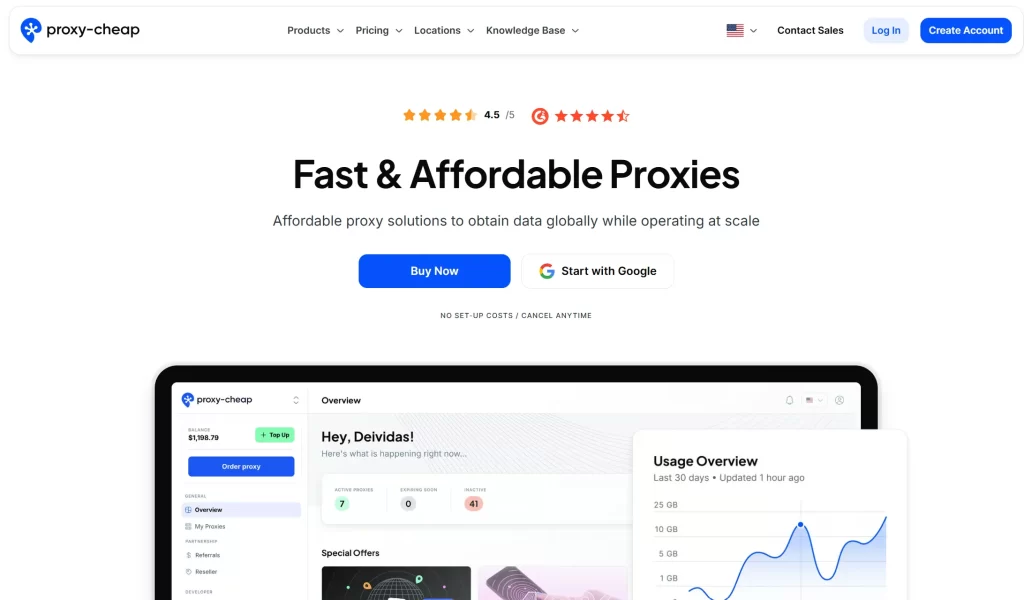
The name says it all. Proxy-Cheap is $0.78/GB rotating residential. The cheapest on this list. 45,000+ customers, 4.5/5 on G2. It exists.
For botting on a shoe-string budget, this is the entry point. No setup, cancel anytime, 200+ countries. Static residential starts at $2.12/month per proxy. ASN quality isn’t well documented, though
What you’re getting for $0.78: shared IP pools with higher burn rates, less transparent ASN sourcing, support that’s lighter than enterprise. But for a new bot testing before a drop? $0.78/GB means you can buy 5GB, run a test, and lose $3.90 if it doesn’t work. That’s the value.
Pros:
- Rotating residential from $0.78/GB – lowest on the list
- No setup fees, no contracts, cancel anytime
- 45,000+ customers, 4.5/5 G2 rating
- 200+ country coverage
- Seven proxy types in one dashboard
Cons:
- ASN sourcing less transparent than premium providers
- Shared pools have higher IP burn rates at scale
- Lower community presence in serious botting forums
| Plan | Price |
|---|---|
| Rotating Residential | $0.78/GB |
| Static Residential (ISP) | from $2.12/month |
| Rotating Mobile | $5.99/GB |
Our take: The low price reflects unclear ASN sourcing and higher shared-pool burn rates. If you want to test before spending, Proxy-Cheap is a great option, but then again Proxying offers free 100MB for testing too.
9. Webshare
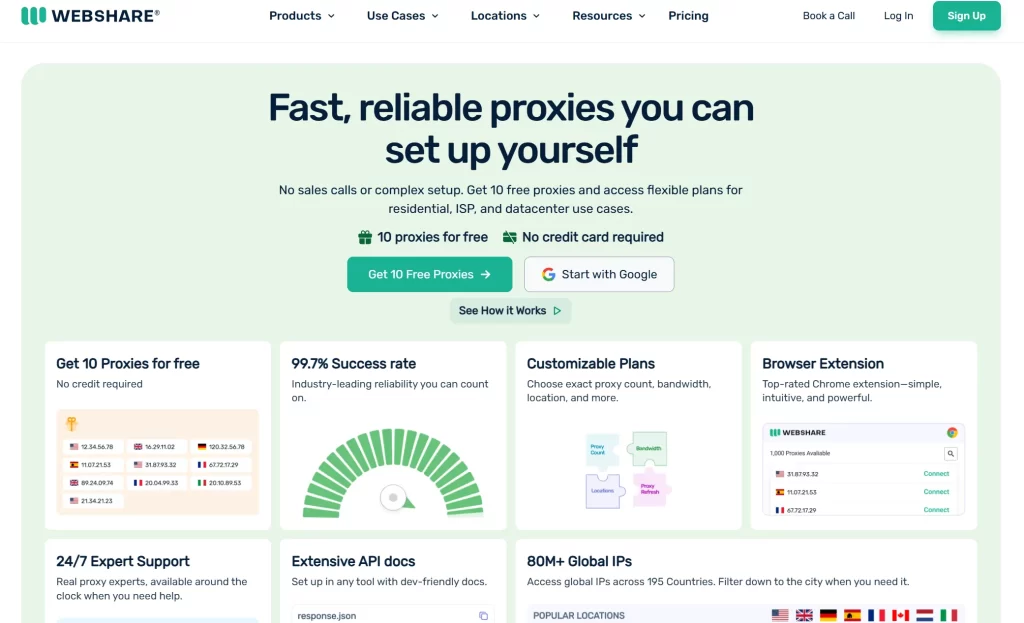
Webshare has one defining feature: 10 permanent free proxies, no credit card needed. If you want to test your bot setup before spending money, this is it.
Beyond free: 80M+ residential IPs, city-level targeting, 99.7% success. ISP tier starts at $0.30/proxy for 20 proxies. Competitive, but ASN documentation is thinner than Proxying.io, and the free tier runs on datacenter IPs, not residential. 64,773+ paid customers, 650B+ monthly requests.
For drops, the free tier is perfect for bot testing. When you need to run real inventory, the paid tiers are solid mid-market. But 99.7% success is below the top tier.
Pros:
- 10 permanent free proxies, no credit card required
- 80M+ residential IPs, 195 countries
- City-level targeting
- ISP proxies from $0.30/proxy (20 proxy tier)
- 650B+ monthly requests processed
Cons:
- 99.7% success rate – below the 99.9%+ premium tier
- Free tier is datacenter, not residential
- ISP ASN documentation thinner than premium providers
| Plan | Price |
|---|---|
| Free tier | 10 proxies forever |
| Rotating Residential | $3.50/month starting |
| ISP Proxy (20 proxies) | $0.30/proxy |
| Datacenter (100 proxies) | $0.0299/proxy |
Our take: The free tier is datacenter proxies, which Pokémon Center blocks. Useful for basic bot configuration testing, but you’ll need residential or ISP proxies for actual drops.
10. Shifter
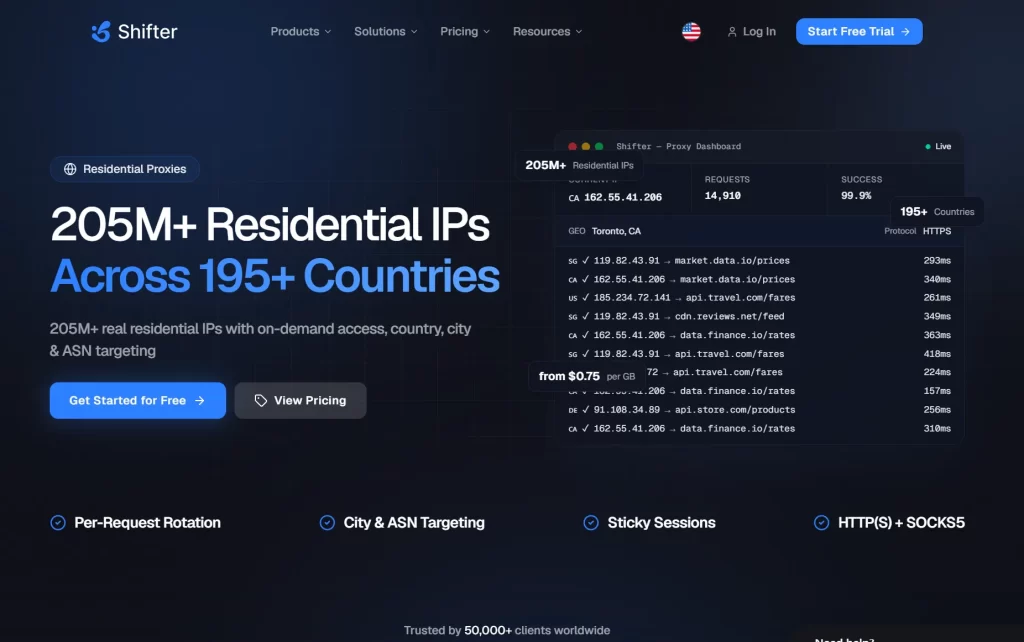
Shifter has been running since 2012. 50,000+ customers, 205M+ IPs. Residential from $0.75/GB with fresh IP per request or sticky sessions up to 60 minutes via TTL. ISP proxies at $1/IP with unlimited bandwidth, 99.9% uptime.
12+ years is meaningful. The network has survived retail drops and scraping wars. TTL-based sticky sessions are technically clean for bot integration – predictable behavior without manual rotation management.
$0.75/GB residential matches Proxy-Cheap but from an older network with better documented reliability. ISP at $1/IP is among the cheapest static residential pricing on this list.
Pros:
- Established since 2012, 50,000+ clients
- 205M+ residential IPs, $0.75/GB starting
- ISP proxies from $1/IP with unlimited bandwidth
- TTL-based sticky sessions up to 60 minutes
- 195+ country coverage, city + ASN targeting
- 99.9% uptime SLA on ISP proxies
Cons:
- Less well-known in Pokémon-specific botting communities
- No published success rate figure (uptime SLA only)
- Documentation is lighter than Bright Data or Oxylabs
| Plan | Price |
|---|---|
| Residential | from $0.75/GB |
| ISP Proxy | from $1/IP |
| Web Scraping API | from $44/month |
Our take: Longevity doesn’t equal ASN quality. No published success rate is a real gap; you’re buying on uptime SLA alone.
ISP Proxies vs Residential Proxies for Pokémon Card Botting
This comes up constantly in botting threads. The answer isn’t “ISP always wins.”
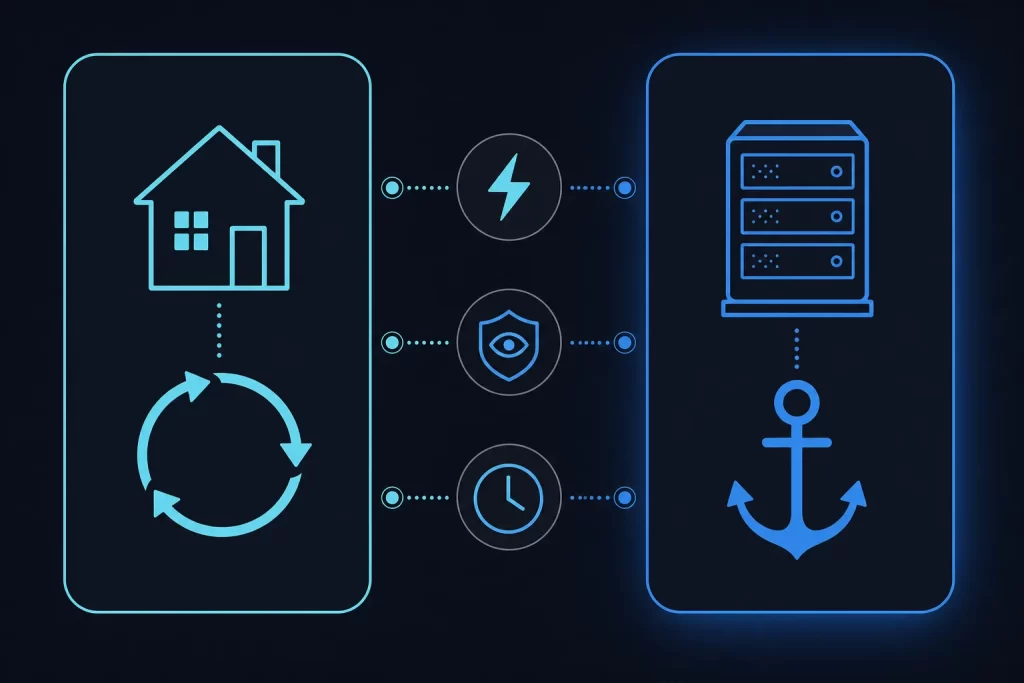
Run ISP when:
- You have 1-10 high-priority checkout tasks that must be completed.
- The site (Pokémon Center) flags non-ISP traffic hard.
- Your checkout takes multiple requests and needs session continuity.
- Latency is the hard constraint.
Run residential when:
- You’re running 100+ simultaneous inventory monitoring threads.
- You need IP diversity across continents.
- The work is watching, not necessarily buying.
- Budget is the real limit.
Smart operations use both: ISP for the checkout threads, rotating residential Pokémon Center proxies for monitoring and backup.