
In 2026, data is no longer just an advantage; it is a requirement. From market research to intelligence and price monitoring, as well as AI training and competitive analysis, businesses rely on timely, structured, and accurate web data. This growing demand has made web scraping APIs an essential part of modern data pipelines.
In this guide, we break down the Best Web Scraper APIs, starting with a clear explanation of what a web scraper API is, followed by the criteria used to rank the providers. We then compare the top platforms to help you evaluate which solution best fits your technical and business needs.
What is a Web Scraper API?
A web scraper API is a cloud-based API interface that allows developers and businesses to do web scraping without building their own scrapers. Instead of handling IP rotation, CAPTCHAs, browser fingerprinting, retries, and bans manually, users send a request to an API endpoint and receive structured data in return.
Modern web scraper APIs typically handle:
- Proxy and IP rotation
- CAPTCHA solving
- JavaScript rendering
- Automatic retries and error handling
- Data formatting (JSON, CSV, HTML)
In 2026, scraper API have become more advanced, often integrating AI-based selectors, no-code workflows, and real-time monitoring. Compared to traditional scrapers with libraries like Selenium, APIs reduce engineering overhead and scale more reliably in production environments. They are much more affordable for clients on a budget.
Why APIs in 2026 are preferred:
- IP rotation & anti-blocking
- Cloud scalability
- Integration with ML pipelines & real-time dashboards
Criteria for Ranking Web Scraper APIs
To ensure a fair and practical comparison, we evaluated each provider using technical and operational criteria relevant to these use cases:
- Ease of Use
- Scalability & Performance
- IP Pool & Geo-coverage
- Data Accuracy & Format Support
- Pricing & Plans
- Anti-blocking & CAPTCHA Handling
- Customer Support & Community
Using these criteria, we have ranked the best web scraper APIs in 2026 based on hands-on testing, reviews, and technical benchmarks.
Comparison Table
| Provider | Ease of Integration | Anti-Blocking & Proxies | JavaScript Rendering | Automation Features | Price |
| Parsera | Simple REST API, clear docs | Managed proxy rotation, CAPTCHA handling | Supported | Scheduling, webhooks | Custom Plan |
| Browse AI | No-code and API access | Built-in bot protection handling | Supported | Visual bots, monitoring | Custom Plan |
| Kadoa | API-first with AI setup | AI-driven anti-blocking | Supported | AI schema detection, auto-adaptation | Starting from $39/month |
| ScraperAPI | Very easy plug-and-play | Large proxy pool, CAPTCHA bypass | Supported | Core scraping only | Offering different plans between $49 to $475 |
| Apify | Moderate learning curve | Proxy management available | Supported | Custom actors, workflows, scheduler | Offering different plans between $29 to $999 |
| Firecrawl | Simple and lightweight | Basic proxy handling | Supported | Clean data output for LLMs | Offering different plans between $16 to $333 |
| Scrapingdog | Medium high | Proxy rotation | Supported | Basic automation | Custom plan |
| Zyte | Very high | Smart proxy management | Supported | Automatic extraction APIs | Offering different plans between $100 to $500 |
| Oxylabs | Very high | Residential & ISP proxy pool | Supported | AI parsing geo-targeting | Custom pricing |
| Geekflare | Simple Rest API, developer friendly | Custom actors, workflows, and scheduler | Supported | Rotating proxies, AI anti-bot bypass | Starting from $9/month |
Detailed Comparison of the Best 10 Web Scrapers APIs
Parsera
Parsera positions itself as a developer-friendly scraper API with a stronger focus on simplicity and automation. It abstracts most scraping complexities, making it suitable for teams that want fast results without extensive configuration.

Features
- Managed proxy rotation
- CAPTCHA handling
- Structured JSON and CSV output
- Webhooks and scheduled scraping
Pros
- Easy to integrate and maintain
- Clean dashboard and workflow management
- God for recurring scraping tasks.
Cons
- Limited customization
- Complicated dashboard for beginners
Best For
Startups and small teams needing reliable scraping with minimal setup
Browse AI
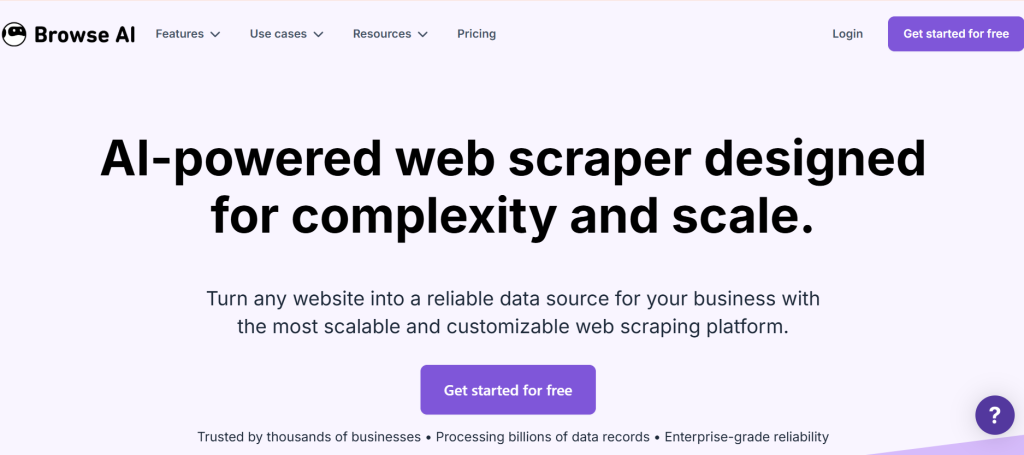
Broowse AI takes a no-code and low-code approach, allowing users to train models that extract data visually. While it offers API access, its main strength lies in automation for non-technical users.
Features
- Visual data extraction
- Prebuilt scraping robots
- API and webhook integration
- Monitoring and change detection
Pros
- Extremely user-friendly
- Fast setup without coding
- Search for monitoring
Cons
Less suitable for very large-scale scraping
Kadoa
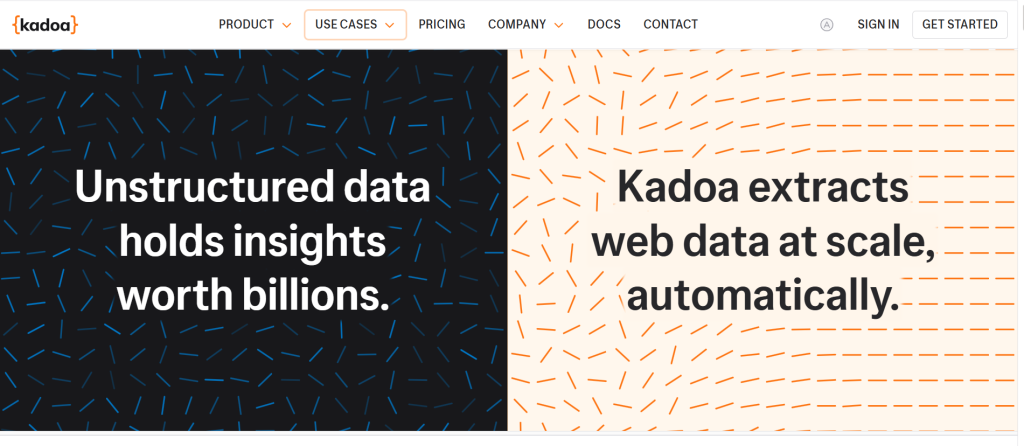
Kadoa differentiates itself with an AI-driven extraction that adapts to website changes automatically. Instead of relying on fixed selectors, it uses AI to understand page structures.
Features
- AI-powered data extraction
- Automatic schema generation
- Change-resilient scraping
- API-first architecture
Pros
- Highly adaptable to dynamic sites
- Reduced maintenance
- Strong for unstructured data
Cons
- Higher pricing than basic APIs
- Less transparency in the extraction logic
Best For
Data teams handling frequently changing or complex websites.
ScraperAPI
ScraperAPI is one of the most widely adopted scraping APIs, known for reliability and straightforward pricing. It focuses on being a universal backend for scraping any website.

Features
- Large proxy pool
- JavaScript rendering
- CAPTCHA bypass
- Simple REST API
Pros
- Stable and battle-tested
- Easy migration from DIY scrapers
- Competitive pricing
Cons
Limited automation features.
Best For
Developers who want a dependable, plug-and-play scraping backend
Apify
Apify is more than a scraping API; it is a full automation platform. It allows users to build custom actors (scrapers) and deploy them at scale.

Features
- Custom scraper actors
- Cloud execution environment
- Scheduler and task automation
- Large marketplace of ready-made scrapers
Pros
- Extremely flexible
- Strong developer ecosystem
- Suitable for complex workflows
Cons
- Steeper learning curve
- Overkill for simple scraping needs
Best For
Advanced users and enterprises require custom scraping logic.
Firecrawl
Firecrawl focuses on clean data extraction, particularly for AI and LLM-related workflows. It emphasizes structured output and content readability.

Features
- Clean HTML-to-text extraction
- LLM-friendly outputs
- JavaScript rendering
- Simple API design
Pros
- Ideal for AI training data
- Lightweight and fast
- Clear output structure
Cons
- Limited proxy customization
- Smaller feature set than enterprise tools
Best For
AI developers and content-focused scraping tasks.
Scrapingdog
Scrapingdog is a cost-effective scraping API designed for developers who need solid performance without enterprise pricing.

Features
- Headless browser support
- Proxy rotation
- CAPTCHA solving
- Global IP coverage
Pros
- Affordable pricing
- Simple API
- Good performance for mid-scale scraping
Cons
- Limited advanced automation
- Smaller IP pool than premium providers
Best For:
SMBs and developers on a budget.
Zyte
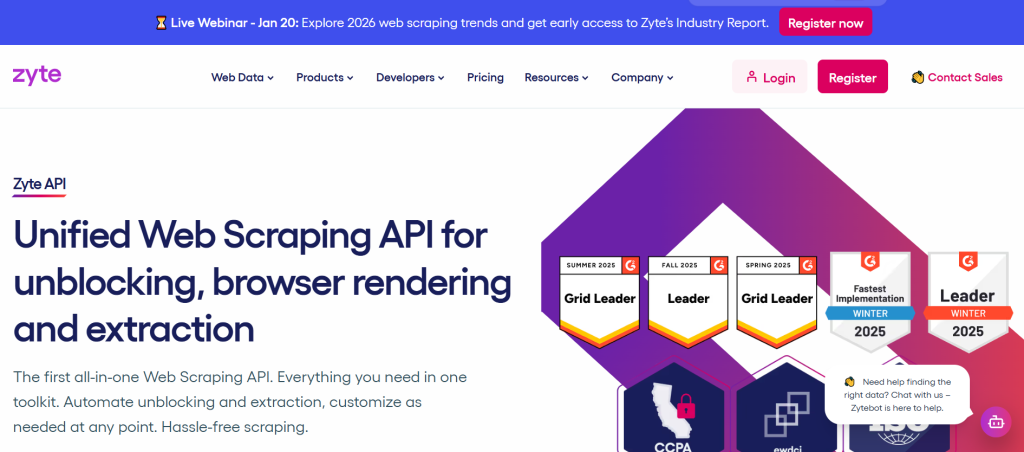
Zyte, formerly Scrapinghub, brings enterprise-grade scraping with a strong focus on compliance and data quality.
Features
- Smart proxy management
- Automatic extraction APIs
- JavaScript rendering
- Compliance-focused scraping
Pros
- Enterprise reliability
- Strong success rates
- Good documentation
Cons
- Higher cost
- Less flexibility for custom logic
Best For
Enterprises prioritizing compliance and data accuracy.
Oxylabs
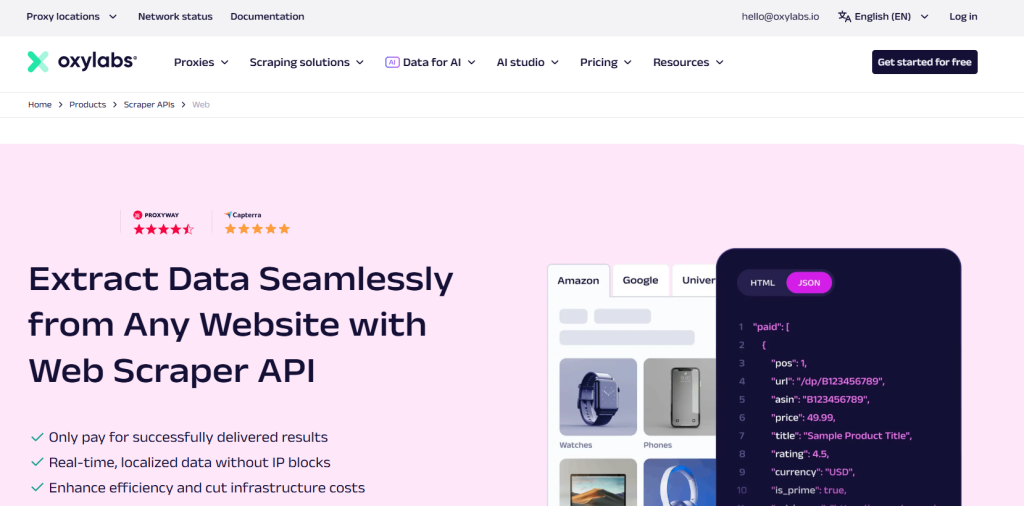
Oxylabs is known for its premium proxy infrastructure and high success rates. Its scraping APIs are designed for large-scale, mission-critical data extraction.
Features
- Massive residential and ISP proxy pools
- AI-powered parsing
- High concurrency support
- Advanced geo-targeting
Pros
- Exceptional performance
- Enterprise-level SLAs
- Excellent documentation
Cons
- Premium pricing
- More complex setup
Best For
Large organizations with high-volume scraping requirements.
Geekflare
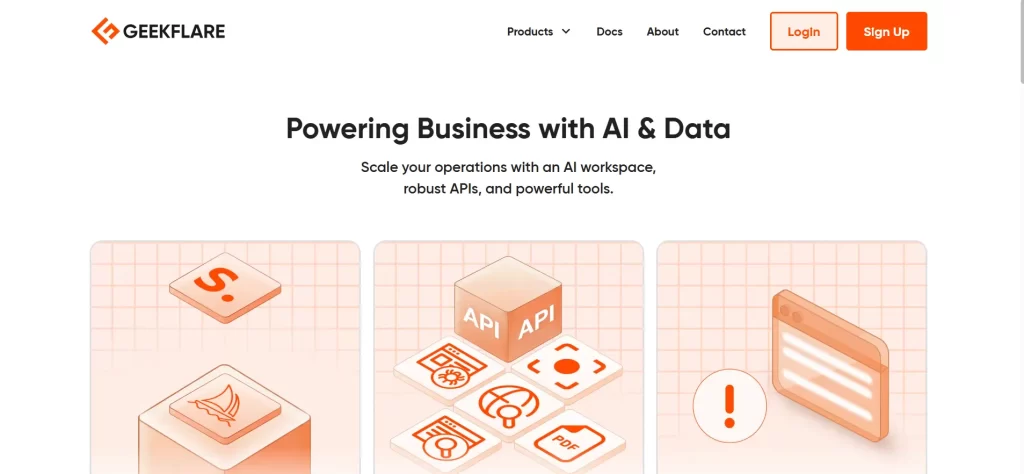
Geekflare has emerged as a practical and accessible platform in 2026, offering advanced tools, APIs, and resources for developers, marketers, and businesses. While not a traditional scraper-provider, Geekflare provides web scraping APIs and tools that focus on usability, learning, and quick deployment.
Features
- Web scraping API tools and utilities
- Pre-tested scripts and developer resources
- Monitoring and testing tools
- API integration for common scraping workflows
Pros
- Beginner-friendly platform
- A wide range of tools beyond scraping
- Helpful for learning and quick implementation
Cons
- Limited proxy infrastructure compared to other providers
- Fewer advanced automation features
Best For
Developers, freelancers, and small teams looking for easy-to-use scraping tools, learning resources, and lightweight data extraction solutions
Also Read
Top 5 Datacenter Proxy Provider Companies
Conclusion
Selecting the best web scraper APIs in 2026 ultimately comes down to how reliably you can access data at scale. While usability and AI-powered automation play an important role, long-term scraping success depends on avoiding blocks, maintaining high success rates, and accessing different location-based IPs. Even the most advanced scraping APIs rely on a strong proxy infrastructure to operate effectively.
This is where residential proxies become critical. By routing requests through real residential IPs, they help scraper APIs blend in with normal user traffic, reduce detection, and ensure consistent data collection across regions. Pairing the right web scraper API with high-quality residential proxies allows you to scale confidently, maintain data accuracy, and future-proof your scraping operations in an increasingly restrictive web.