
An IP(Internet Protocol) is a unique numerical label assigned to each device connected to a computer network, such as the Internet. It is similar to the cellphone number, a unique combination of numbers that allows users to communicate with each other.
It serves two main functions
- Provides an identity to a device on the network.
- Allows devices to connect over the Internet.
Think of it as the address of your computer on the internet, enabling it to send and receive information.
- Identification: Like a house address, an IP address uniquely identifies your device among the billions connected to the internet.
- Location: It contains location information, which is crucial for directing data traffic across the network to its intended receiver.
- Function: It is used by the Internet Protocol (IP) to facilitate communication by ensuring data is formatted and sent between devices properly.
- Assignment: Your ISP typically assigns the IP address to your devices.
What are the Types of IPs?
There are two main versions currently in use:
- IPv4
- IPv6
What are IPv4 and IPv6?
As we already mentioned, IPv4 and IPv6 are different types of IP addresses, with the same purpose:
- User identification
- Communication over the internet
IPv4 Addresses
An IPv4 address is a 32-bit numerical label used to uniquely identify devices on a computer network. It is typically written in dotted-decimal notation, which consists of four decimal numbers (0-255) separated by periods (e.g., 194.23.32.1). It was developed in the early 1980s.
Its primary functions are:
- Purpose: It acts like a digital street address, ensuring data packets are sent to the correct device on a network.
- Format: IPv4 addresses are made of four numbers, each representing a byte, and are separated by dots.
- Structure: The address is divided into two parts:
- Network ID: Identifies the network the device is on.
- Host ID: Uniquely identifies the specific device on the network.
- Limitations: Due to the rapid growth of the internet, the limited number of available IPv4 addresses is a major issue, which has led to the development of IPv6.

The number of IPv4 address combinations is limited. Overall, you can count over 4 billion unique addresses. At the very beginning of the IPv4 type, this number seemed never to expire.
But in 2015, it was officially announced that the US had run out of IPv4 addresses.
IPv6 Addresses
An IPv6 address is a 128-bit alphanumeric label that identifies and locates a device on a network, designed to replace the 32-bit IPv4 addresses.
Written using 8 groups of 4 hexadecimal digits separated by colons, it provides a vastly larger pool of addresses to support the growing number of internet-connected devices. This increased address space helps you overcome the exhaustion of IPv4 and improves routing and scalability.
Key Features of IPv6 Addresses
- Length: They are 128-bit, compared to IPv4’s 32-bit addresses, offering a large number of unique addresses.
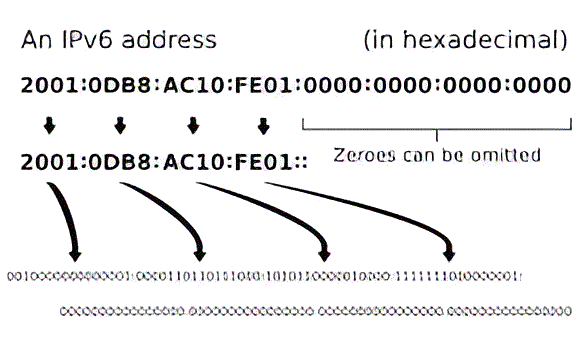
- Format: They are written in hexadecimal and separated by colons, for example, 2001:0db8:85a3:0000:0000:8a2e:0370:7334
- Abbreviation: IPv6 addresses can be shortened by removing leading zeros in each group and replacing them with a double colon (: :), through the latter can be used once per address.
- Purpose: They act as unique identifiers for the network devices, enabling data transfer and communication by providing a destination for data packets.
Like every combination, IPv6 also has a limited number of possible IP address options. However, in this case, the number is slightly different. It has over 3.4×10^38 addresses.
What is the Difference Between IPv4 and IPv6?
Both types of IP addresses are used for users’ identification and communication between different devices over the internet.
The main difference is that IPv6 uses a 128-bit address, providing a nearly inexhaustible supply of unique addresses, while IPv4 uses a 32-bit address with a limited number of addresses.
IPv6 is the newer, more advanced version that includes built-in security with IPSec, automatic configuration, and more efficient routing compared to IPv4, which requires external security measures like firewalls and NAT.
| Feature | IPv4 | IPv6 |
| Address Length | 32-bit | 128-bit |
| Address Space | 4.3 billion addresses | 340 undecillion addresses |
| Address Format | Dot-decimal notation (e.g., 192.168.1.1) | Hexadecimal notation (e.g., 2001:0db8::1) |
| Security | No built-in security; relies on external measures like firewalls | Built-in IPSec for encryption and authentication |
| Configuration | Manual or DHCP | Automatic configuration, renumbering, or DHCP |
| Fragmentation | Performed by both the sender and the routers | Performed only by the sender |
| Routing | Broadcast is common, inefficiently sending to all devices | Multicast is built0in for efficiency, with no broadcast messages. |
Type of Addresses
IPv4 uses three types of addresses,
- Unicast: It is meant for one-to-one communication.
- Multicast: It is meant for one-to-many communication.
- Broadcast: It is for sending data to all devices.
IPv6 eliminates the broadcast method to reduce unnecessary network traffic. Instead, it introduces anycast addressing, where a single address can be assigned to multiple devices, and the data is delivered to the nearest one, making it more efficient.
Packet Size
In IPv4, packet sizes can carry between 20 bytes (minimum) and 65535 bytes (maximum). While this range has worked for years, it can be limiting in modern high-bandwidth environments.
IPv6 supports much larger packet sizes and introduces the concept of a Jumbo Payload. It allows packets to exceed 4 million bytes.
Number of Header Fields
IPv4 has 12 header fields, including version, header length, identification, flags, and checksum, among others. This makes it slightly more complex for routers to process.
IPv6 simplifies this by reducing the number of header fields to eight, removing redundant fields. With fewer fields to process, IPv6 allows for faster packet forwarding and more efficient data handling.
Configuration
IPv4 usually requires manual configuration or uses DHCP to assign IP addresses. This process can be time-consuming for large networks.
IPv5 simplifies the steip with SLAAC, which enables devices to automatically generate their own IP addresses without any manual input.
Security
Security is IPv4 in not built-in, it depends on optional tools like IPsec or third-party encryption solutions.
IPv6 was designed with security. It integrates IPsec, providing end-to-end encryption, data integrity, and authentication by default.
Compatibility with Mobile Devices
IPv4 was not originally designed for mobile connectivity, leading to challenges like session drops and address changes when devices move across networks.
IPv6 overcomes this limitation with Mobile IPv6, a feature that allows mobile devices to maintain the same IP address while roaming between different networks.
The Main Feature
The main feature of IPv4 lies in its simplicity and widespread support; it remains the backbone of the internet.
However, IPv6 has characteristics of a massive address space, allowing trillions of unique addresses for every connected device.
IPv4 vs. IPv6: Which One to Use?
IPv4 is still one of the widely used Internet protocols today. It’s compatible with almost every device, server, and network setup. If you are working with legacy systems, older routers, or applications that don’t support IPv6.
IPv6 is the future of the Internet. It provides a wider range of IP addresses, built-in security, and better performance on modern, mobile, and IoT-heavy networks.
Conclusion
While IPv4 remains reliable and widely supported, IPv6 is the clear path forward for scalability and security. Its modern design supports the growing number of connected devices worldwide. For the best balance, adopting a dual-stack approach ensures smooth transition and future readiness.