
Pokémon cards sell out in seconds. Not minutes – seconds. If you’ve ever refreshed a product page only to find it already gone, you’re not alone, and you’re not doing anything wrong. The cards just move faster than any human can click “Add to Cart.”
The good news: there are real systems you can build to get ahead of drops. This guide covers where to buy Pokémon cards online, how to track restocks at each major retailer, and the tools that serious collectors use to actually land cards before they’re gone.
Why Pokémon Cards Sell Out So Fast
Three things converge to make this difficult:
- Supply constraints. Hyped sets like Prismatic Evolutions and Surging Sparks get allocated in limited quantities even at major retailers. Pokémon Company controls the print run, and stores can only sell what they receive.
- Bot competition. Scalpers run automated checkout bots that add to cart and complete payment faster than any human can. By the time you see the product is in stock, it may already be sold.
- Viral demand spikes. A single TikTok or YouTube video can clear regional stock within hours. Social media virality drives demand that brick-and-mortar and online inventory simply can’t absorb.
The result: over 6,000 active monitors on Visualping alone are tracking Pokémon product pages. About one in three of those pages saw a stock change in the last 30 days. This is an active, high-stakes environment – and the people who land cards consistently are the ones with systems, not luck.
Where to Buy Pokémon Cards Online
Not every retailer follows the same restock pattern. Some release inventory on predictable days, while others drop products without warning. Knowing how each store operates helps you decide where to monitor most closely.
Pokémon Center
The official Pokémon store is the first place for exclusive products, Pokémon Center editions, and special releases. It’s also the most competitive retailer to buy from. Major launches attract huge traffic, and strong bot protection means products can disappear within minutes.
Unlike most retailers, Pokémon Center doesn’t follow a reliable restock schedule. New products and restocks can appear at any time, making it one of the hardest stores to predict. Your best bet is to monitor the New Arrivals page alongside the individual product pages for the sets you’re interested in.
Target
Target is one of the more predictable retailers for Pokémon card restocks. Online inventory most commonly appears on Tuesdays and Thursdays, making those the best days to watch for new stock.
Checking the Trading Cards section during the morning is usually enough. A 15-minute monitoring interval works well for regular tracking, while 5-minute checks make sense around major product launches.
Walmart
Walmart is less consistent than Target, but Wednesdays tend to be the most active day for Pokémon card inventory. Restocks can happen throughout the day, so it’s worth monitoring regularly rather than relying on a specific hour.
When shopping on Walmart, always filter for products that are Sold and shipped by Walmart. Marketplace sellers frequently charge well above retail prices.
Amazon
Amazon doesn’t follow any reliable restock schedule. Products can become available at any time and often sell out within minutes, especially for popular sets.
Monitor the specific product listing you’re interested in instead of Amazon search results. A 5-minute check interval gives you the best chance of catching brief restocks.
GameStop
GameStop is another retailer with an unpredictable release schedule. Restocks and pre-orders can appear without much notice, particularly for exclusive bundles and special products.
If you’re waiting for a specific release, monitor the product page directly. When a pre-order opens, it’s usually worth acting quickly because availability often doesn’t last long.
4 Methods to Track Pokémon Card Restocks
There’s no single approach that works for everyone. The right setup depends on how serious you are, which retailers you’re targeting, and how much you want to automate.
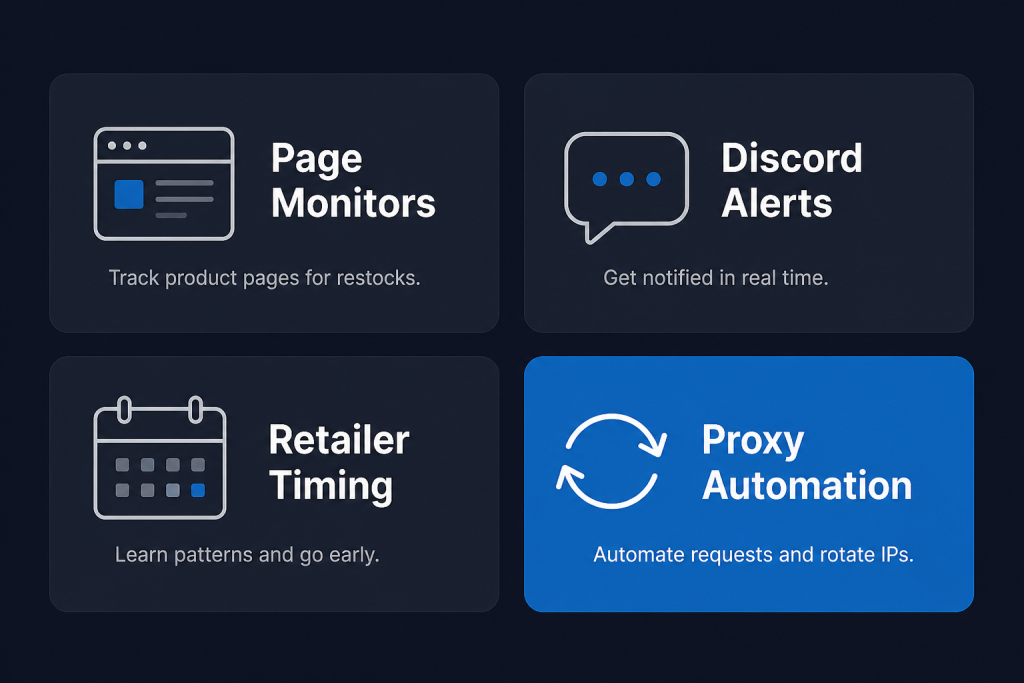
1. Page Monitoring Tools
The most reliable starting point for most collectors. These tools watch a specific element on a product page – typically the Add to Cart button – and alert you the moment it changes state.
Visualping is the most precise option. You can pin it to the exact cart button on a product page and set check intervals down to 5 minutes on paid plans. With over 6,000 active Pokémon monitors, it’s clearly the tool of choice in the community.
Restockd offers real-time push notifications for Pokémon cards, GPUs, and collectibles. Its mobile-first design makes it practical for checking alerts when you’re not at a desktop.
RestockR X is a faster mobile notification app purpose-built for TCG products, available on iOS.
The practical limit of page monitors: they tell you when stock appears, but the time between the alert and your click still has to compete against bots and other humans with the same alert. For more popular drops, a monitor alone may not be enough.
2. Discord and Reddit Alerts
Community-run Discord servers and Reddit communities are often faster than commercial monitoring tools because human spotters can catch drops before automated systems do. The most active communities:
- r/PokemonReStocked (7,600+ members)
- r/pokemonrestockr (16,300+ members)
- r/PokemonDeals and r/PokemonDealsUK
- Regional Discord servers with their own bots monitoring retailer pages
These communities work best as a supplement to page monitors, not a replacement. Relying on someone else to post a restock before you can act adds unpredictable lag.
3. Retailer Timing Patterns
Once you internalize the patterns above – Target weekday mornings, Walmart Wednesday for new releases, GameStop business hours – you can concentrate your manual checking during those windows instead of monitoring 24/7. This won’t catch every drop, but it significantly improves your odds for the predictable ones.
4. Proxy Automation
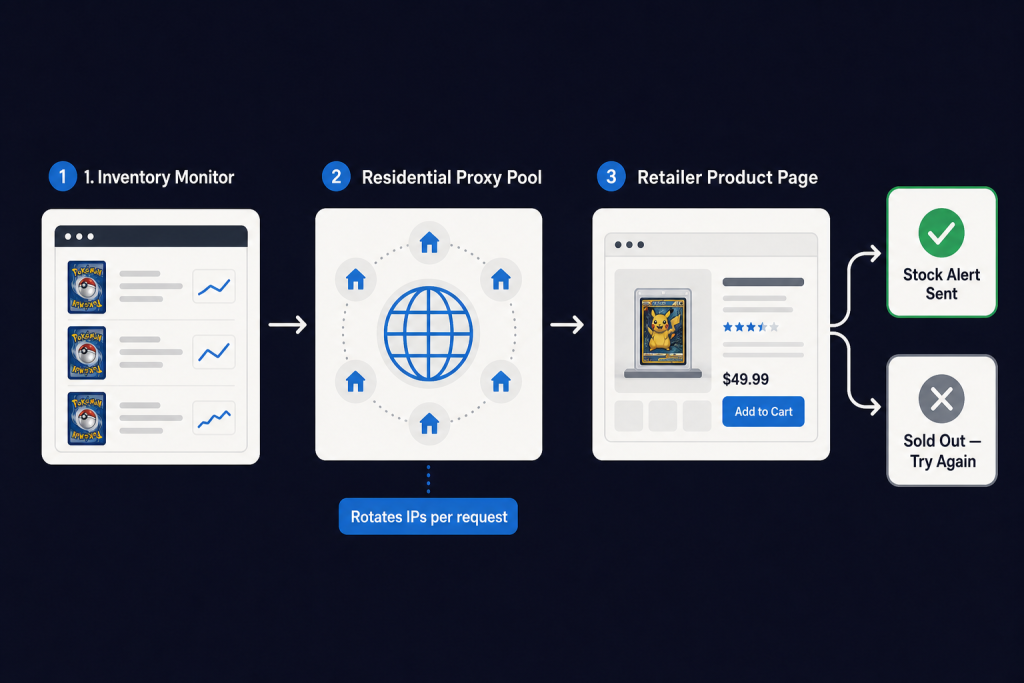
This is how serious collectors compete with scalper bots. If monitoring tools tell you when stock appears, Pokémon Center proxies help you act on it faster and at scale – across multiple retailers simultaneously, without getting blocked.
Here’s the core challenge: when you run any automated script that frequently checks inventory pages, retailers’ bot-detection systems will eventually flag your IP address. You get rate-limited, blocked, or served CAPTCHAs. Proxies solve this by routing your requests through different IP addresses so no single IP triggers thresholds.
For Pokémon Center specifically, residential proxies are essentially required. Pokémon Center’s Akamai/PerimeterX protection distinguishes residential IPs (tied to real ISPs like Comcast or AT&T) from datacenter IPs (server farms), and datacenter proxies get blocked at a high rate. Residential proxies are harder to detect and much more likely to get through.
For sustained monitoring across multiple retailers, ISP proxies (static residential IPs from premium ASNs) offer a good balance of speed and detectability. They’re faster than rotating residential proxies and hold up well on sites that aren’t as aggressively protected as Pokémon Center.
While free proxies may seem like a cost-saving option, they are often slow, overcrowded, and already flagged by retailers, making them unreliable for Pokémon card monitoring and automation. If you’re thinking about using free proxies, check out our guide on why free proxies are rarely worth the risk before getting started. Instead, you can try Proxying’s premium residential and ISP proxies with a 100 MB free trial available after joining our Discord and Telegram communities.
If you’re monitoring multiple retailers simultaneously, each site needs its own proxy pool to avoid cross-contamination – a ban on one site shouldn’t affect your monitoring on another.
Choosing the right proxies is only the first step. Our guide on how to reduce proxy bans during Pokémon Center drops explains how to configure them correctly so you can avoid unnecessary blocks during high-demand releases.
Automation Bots: What They Do and What They Require
For collectors who want full checkout automation – not just alerts – dedicated purchasing bots take things further. These tools don’t just notify you; they add to cart and complete checkout automatically when stock appears.
Stellar AIO is the most capable option specifically for Pokémon Center. It has a dedicated Pokémon Center module and handles the site’s bot detection better than more general-purpose tools. It trades on the secondary market for $100 to $300, depending on availability.
BotBro covers a broader set of retailers and is worth considering if you’re targeting multiple sites.
Nike Shoe Bot started in sneaker drops and expanded to TCG products – it’s familiar to a lot of collectors coming from the sneaker resell world.
All of these bots share the same requirement: they need proxies to function (Especially residential proxies). Without rotating IPs, any bot running repeated checkout tasks will get flagged and blocked quickly. Each bot task typically needs its own IP pool, with separate pools per site to prevent bans from cascading across retailers.
The proxy requirements for bots are more demanding than for simple monitoring:
- Proxy rotation on every request, so no single IP is making the same repeated calls
- Browser fingerprint spoofing to match realistic user agent strings, screen resolutions, and WebGL signatures
- CAPTCHA bypass capability, especially for Pokémon Center, which fires challenges actively during drops
Choosing the right proxy type is just as important as choosing the right bot. If you’re unsure whether residential or ISP proxies are the better fit, read our guide on which proxies are best to use with Pokémon Center to understand which option works best for monitoring, queues, and checkout.
Building a Practical System
You don’t need everything above to improve your chances meaningfully. Here’s how to think about layering these tools based on how serious you are:
Casual collector: Set up Visualping on the 3-4 product pages you care about. Join r/PokemonReStocked. Check Target’s site (Tuesdays and Thursdays) and Walmart’s (Wednesdays) for new releases. This covers most of what you need without any automation.
Regular buyer: Add Restockd or RestockR X for mobile push alerts. Learn the timing patterns for each retailer you target. Monitor both individual product pages and new arrivals grids at Pokémon Center.
Serious collector/competitive buyer: Set up proxy-backed monitoring across retailers. Use residential proxies for Pokémon Center, ISP proxies for sustained multi-site monitoring. Consider a dedicated AIO bot if you’re targeting high-demand drops where manual checkout isn’t competitive.
The community consensus from r/PokemonInvesting offers a useful counterpoint:
“Don’t buy new cards as soon as they drop. Wait 2-3 months before buying. They’ll almost always drop in value.”
If you’re buying to collect and play rather than to resell or beat scarcity, patience is often the most cost-effective strategy.
2026 Notable Releases to Watch
A few sets worth having on your radar this year:
- Prismatic Evolutions (January 2026) – extremely high demand, with ongoing restock waves through the year
- Surging Sparks – restocks continuing through early 2026
- Scarlet & Violet sets – new sets dropping quarterly throughout 2026
For Pokémon Center, monitor pokemoncenter.com/category/new-arrivals and the official Pokémon TCG page at pokemon.com/us/pokemon-tcg during launch windows. Set your check intervals to 5-10 minutes during those periods.
Try Proxying for Pokémon Card Monitoring
If you’re running any form of automated monitoring or checkout automation, proxy quality is the variable that determines whether your setup actually works – especially on Pokémon Center.
Proxying offers residential, ISP, and datacenter proxies with 10M+ IPs across 190+ locations. The residential pool is what you need for Pokémon Center’s aggressive bot detection. ISP proxies work well for sustained multi-retailer monitoring where you need static IPs with high speed.