
Pokémon Center’s limited-edition releases, Elite Trainer Boxes, Special Illustration Rare sets, anniversary collections, move so fast that manual checkout is essentially lottery-level. A Reddit thread in r/shoebots discussing the current best Pokémon center bot pulled 610+ comments, which tells you everything about how competitive the space is. We went through the top options, weighed the pricing, and looked at what the community actually uses.
What Makes a Good Pokémon Center Bot
Not all retail bots are built the same. The features that matter for Pokémon Center drops specifically:
- Dedicated module with active maintenance. Pokémon Center updates its checkout flow regularly, and bots that don’t keep up miss drops. A dedicated module is the single biggest differentiator between bots that actually check out and ones that error out mid-drop.
- Guest checkout support. Account-based checkout means verification delays. Guest mode is faster and avoids the account flagging risk on high-demand items.
- Proxy support with rotation. Rotating residential proxies per task (not per session) is the gold standard. Any bot worth running needs to support this natively.
- Task groups and scheduling. Drop timing matters to the millisecond. The ability to pre-schedule tasks and run hundreds in parallel is what separates a casual setup from a serious one.
- CAPTCHA handling. Pokémon Center throws challenges during high-traffic events. A bot without a CAPTCHA integration is going to stall exactly when it counts.
The Best Pokémon Center Bots in 2026
| Bot | Best For | Pricing | Direct Pokémon Center? |
|---|---|---|---|
| Stellar AIO | Dedicated Pokémon Center drops | $100-300 (secondary market) | Yes |
| Valor AIO | Pokémon Center, Multi-retail coverage | $1999.99 for access + $49.99/month | Yes |
| Refract | TCG products on Target/Walmart/Amazon | $19.99 / 3 months, then $50/mo | Not directly |
| Shikari | Multi-retail automation | Monthly subscription (varies by plan) | Yes |
| BotBro | Multi-retail coverage | $50-150/month | Multi-site |
| Nike Shoe Bot | Teams crossing over from sneaker botting | $346/6 months | Multi-site |
1. Stellar AIO: Best for Direct Pokémon Center Drops
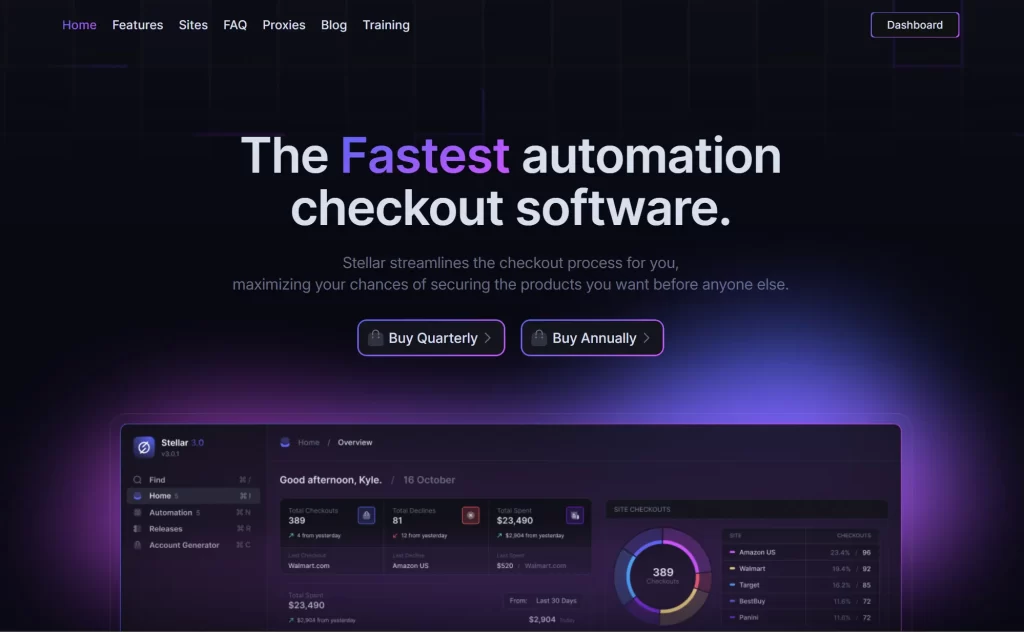
Stellar AIO is the closest thing to a consensus pick in the Pokémon Center botting community. The Decodo 2026 guide calls it “the most battle-tested option for Pokémon Center specifically,” and the community data backs that up: a step-by-step Stellar AIO tutorial has pulled 22.8K+ views on YouTube, which is a meaningful signal of how widely used it is.
What sets Stellar apart from generic retail bots is its dedicated Pokémon Center module. The team maintains it actively, meaning when Pokémon Center updates its checkout flow or tightens anti-bot detection, Stellar pushes a patch rather than leaving users to figure it out. That maintenance cadence is the core reason it leads.
The catch: Stellar AIO does not sell through a public storefront at a fixed price. Licenses trade on secondary markets like Tidal, typically in the $100-300 range depending on demand. When a major set is dropping soon, that price can spike. If you’re buying for the first time, time your purchase during a quiet period.
The Stellar AIO Pokémon Center guide walks through configuration from scratch, including guest checkout setup, proxy configuration, and CAPTCHA harvester integration. It’s worth reading before your first drop day.
2. Valor AIO: Best Consistent Performance
Valor AIO has become one of the strongest alternatives for Pokémon Center botting, especially for users who want reliable performance without constantly tweaking their setup. While Stellar remains the most established choice, Valor has built a reputation for adapting quickly to Pokémon Center changes and maintaining competitive success across high-demand releases.
One of Valor’s biggest strengths is its actively maintained Pokémon Center support. The developers regularly update the bot after site changes, helping users stay functional when checkout flows or anti-bot measures evolve.
Unlike many Pokémon Center bots that trade almost exclusively on resale markets, Valor has shifted to a premium retail pricing model. A new license costs $1,999.99, which includes the first 30 days of access, followed by a $49.99/month renewal. Rather than offering open sales, Valor primarily operates through a waitlist with limited releases, making availability just as much of a hurdle as the price itself.
3. Refract: Best for Pokémon TCG on Major Retailers
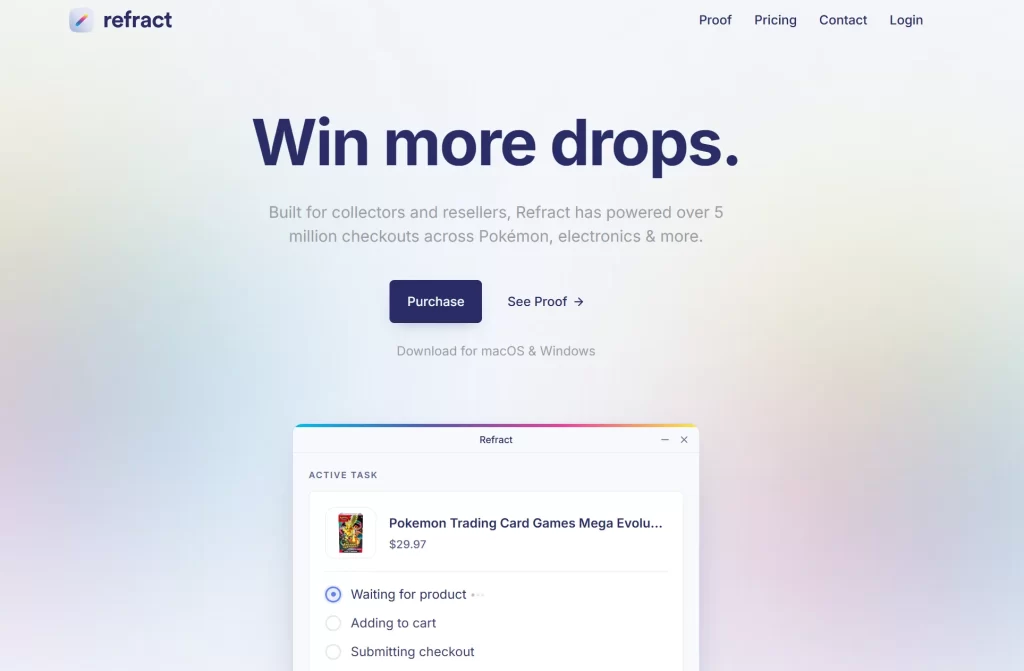
Refract runs a different play. Rather than focusing on Pokémon.com/store, it targets the major retailers where Pokémon TCG products also drop: Amazon, Target, Walmart, Best Buy, and Apple. The homepage stats are real: 5 million+ successful checkouts, with the top items being Pokémon SV10 Destined Rivals Elite Trainer Boxes (20.3K+ checkouts), Prismatic Evolutions collections (13.6K+ checkouts), and more.
For collectors who are less concerned about buying from Pokémon.com specifically and more concerned with securing product at retail price, this is a strong case. Target and Walmart often restock Pokémon TCG items online during the same high-demand windows, and Refract’s multi-retailer coverage means you can run tasks across all of them simultaneously. If you’re still deciding where to buy Pokémon cards at the best price, Refract covers most of those channels natively.
Pricing is straightforward: $19.99 for the first three months (billed upfront), then $50/month. Add $50/month for each additional device. The software runs locally, which means no cloud fees and no data leaving your machine. A built-in 2FA puller handles authentication codes automatically so checkout doesn’t stall waiting on your inbox.
What Refract does not do: It does not currently support direct Pokémon.com checkout. If your strategy requires Pokémon Center specifically (not Target/Walmart/Amazon), Stellar is the right call.
4. Shikari: Best for Fast Pokémon Center Automation
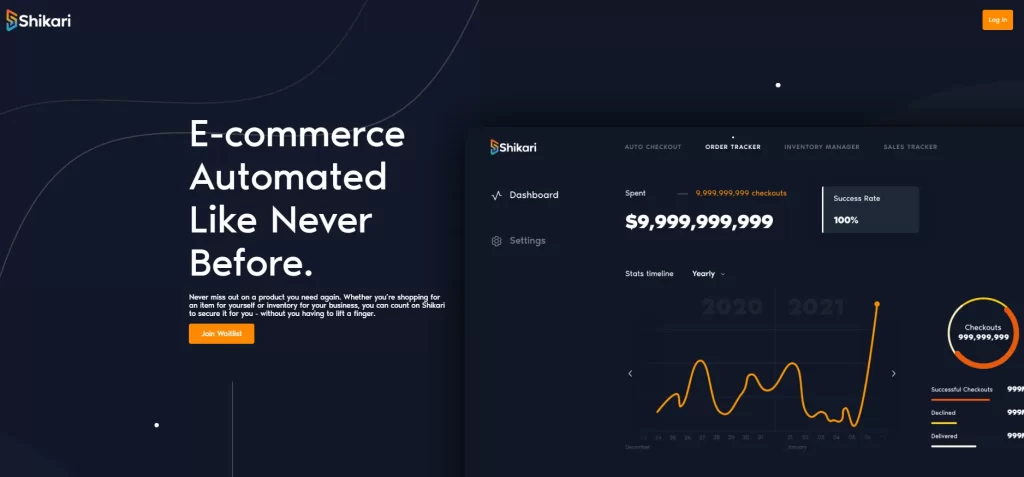
Shikari has become a popular option among Pokémon botters thanks to its strong Pokémon Center support and fast update cycle. Rather than focusing on a single retailer, it supports multiple retail sites while maintaining dedicated modules for high-demand Pokémon releases.
One of Shikari’s biggest strengths is speed. The developers are known for pushing updates quickly whenever Pokémon Center changes its checkout flow or anti-bot protections, helping users stay operational during major restocks. The bot also offers advanced task scheduling, profile management, proxy integration, and CAPTCHA support, making it suitable for users running multiple tasks simultaneously.
Like most premium retail bots, Shikari works best when paired with high-quality residential or ISP proxies. Using clean IPs greatly improves checkout success while reducing bans during limited Pokémon Center drops.
Shikari is offered as a subscription service, with pricing depending on the selected plan and current availability. Because licenses are often released in limited quantities, users may need to join the waitlist or purchase during scheduled releases
5. BotBro: Best All-Rounder
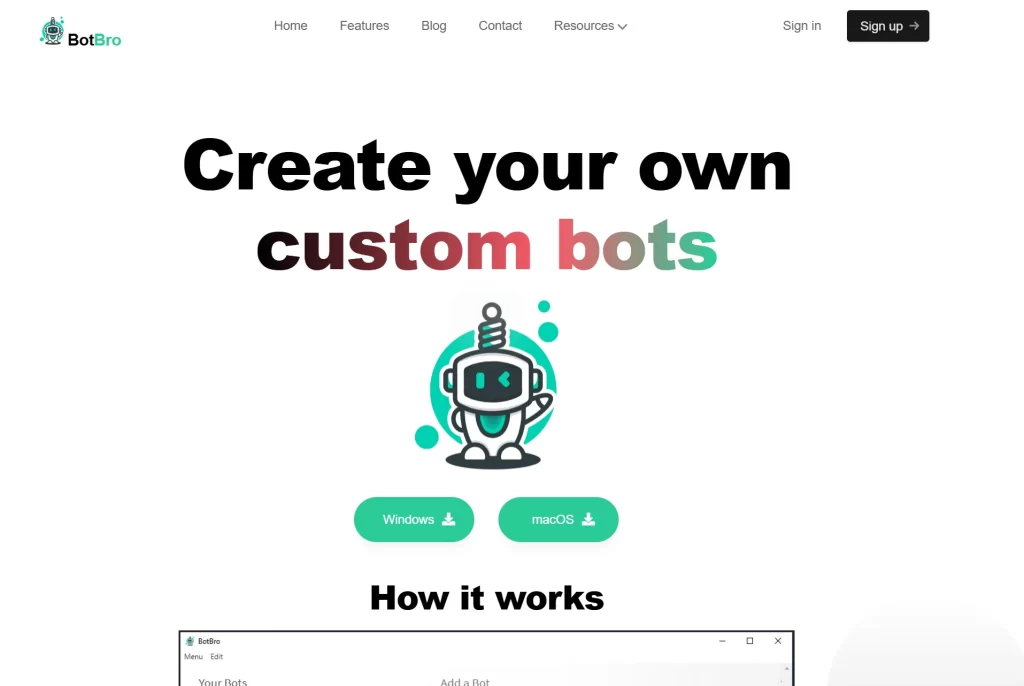
BotBro positions itself as the broad-coverage option in the space. Where Stellar is Pokémon-optimized and Refract focuses on a specific set of retailers, BotBro is built for teams covering multiple retail channels simultaneously.
Proxy management is a standout feature: BotBro supports pool isolation per site, so your Pokémon Center tasks run on a separate IP pool from your Target tasks. Cross-site proxy contamination is one of the more common reasons bots fail across retailers during the same drop window, and BotBro’s architecture accounts for it.
Pricing sits in the $50-150/month range on a subscription model. That’s comparable to Refract’s ongoing monthly cost but with broader site coverage. The tradeoff is that the Pokémon Center module is not as actively maintained as Stellar’s.
6. Nike Shoe Bot (NSB): Best for Teams Crossing Over from Sneaker Botting
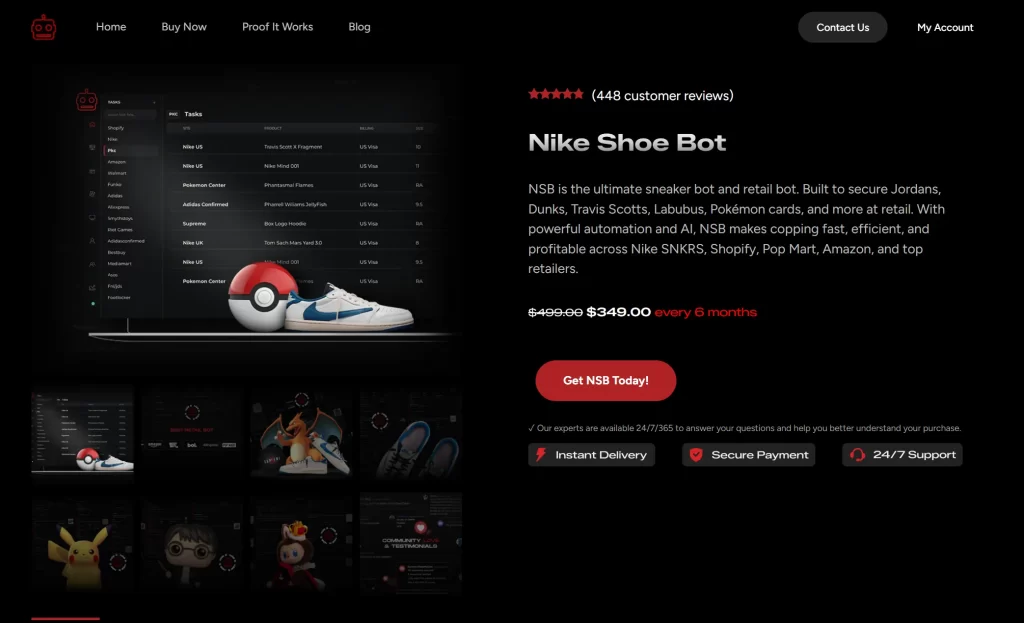
Nike Shoe Bot has been running since the early days of sneaker botting, which gives it a track record most retail bots can’t claim. The team has expanded from footwear into general retail, including Pokémon TCG products on major retailers.
If your team already runs NSB for sneaker drops, adding Pokémon TCG to your coverage requires minimal setup changes: you already have the proxy infrastructure, the cook group connections, and the task management experience. NSB runs on a subscription basis and supports the major retailers where Pokémon products move..
Why Residential Proxies Are Non-Negotiable for Any Pokémon Center Bot
Here’s where a lot of first-time Pokémon Center botters go wrong: they try to run on datacenter proxies, get immediately banned, and assume the bot doesn’t work.
Pokémon Center’s anti-bot system (like most major retailers) maintains blocklists of datacenter IP ranges. The moment a request comes from a known datacenter ASN, it’s flagged before the drop even starts. The only viable proxy type for Pokémon Center drops is residential or ISP. For a detailed breakdown of which option fits which use case, which proxies are best to use with Pokémon Center, covers the tradeoffs in full.
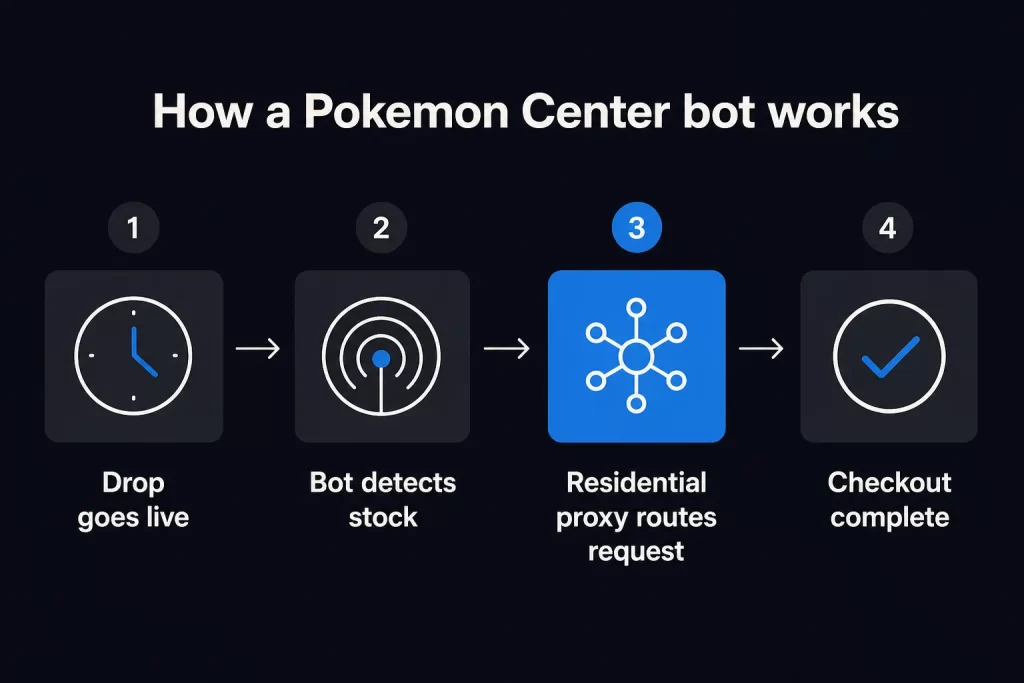
Residential proxies use IP addresses assigned to real household internet connections. Traffic from these IPs looks identical to a human shopper browsing from home. They rotate per request (or per session minimum), which prevents any single IP from triggering rate-limiting.
ISP proxies (also called static residential proxies) are the stronger choice for Pokémon Center proxies where session continuity matters: same IP tied to the same account throughout checkout, rather than rotating per request.
The technical requirements break down by scale:
| Setup | IPs Needed | Est. Monthly Proxy Cost |
|---|---|---|
| Single account (1-5 tasks) | 10-20 residential | $15-50 |
| 5-account setup | 50+ residential | $50-150 |
| 10-account setup | 100+ residential | $100-300 |
| Enterprise (20+ accounts) | 200+ residential | $300+ |
Proxy pool isolation also matters: run separate pools for each retailer. If you’re hitting Pokémon Center and Target in the same drop window, don’t share the same proxy pool between them. A ban on one site’s pool can contaminate your other tasks. Reducing proxy bans during Pokémon Center drops walks through the session configuration that keeps your setup clean.
Not all residential and ISP providers hold up the same way under drop conditions. The breakdown of proxies for Pokémon card botting compares the top options on ASN quality, success rate, and PAYG pricing, so you’re not guessing when you buy.
What Pokémon Center Bots Actually Costs
A YouTube breakdown with 52.4K views ran through the real numbers. The total cost to get started runs between $100 and $550 depending on your approach.
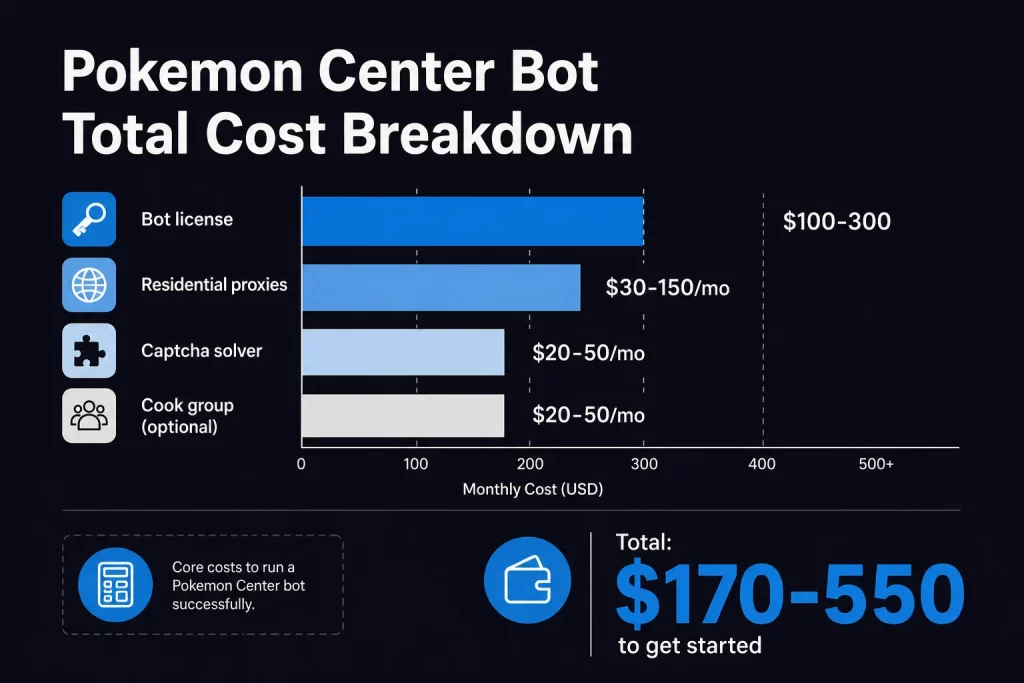
Here’s how the components stack up:
- Bot software: $19.99-100 to start (Refract’s intro pricing) or $100-300 for a secondary-market Stellar AIO license. Valor starts from $1999.99.
- Residential proxies: $30-150/month depending on volume and provider.
- CAPTCHA solver: $20-50/month, two or more harvester instances to avoid bottlenecks during high-traffic drops.
- Cook group (optional): $20-50/month, paid communities that provide early drop links, product IDs, and proxy recommendations.
The variable you control most is proxies. Pay-per-use residential proxy providers like Proxying ($1.50/GB) let you scale up for a specific drop and scale back during quiet periods, rather than paying a flat fee for capacity you’re not using. They also offer 100MB free on joining their Discord or Telegram community, which is enough to run a test before a real drop.
On the margin side: a Pokémon Prismatic Evolutions Super Premium Collection Box that retails for $120-150 regularly sells for $250-400 on secondary markets. A single successful checkout recovers a meaningful share of monthly operating costs. Understanding how to buy Pokémon cards online before they sell out across multiple retailers is what separates one-off wins from a consistent strategy.
How to Set Up a Pokémon Center Bot
The setup flow is consistent across all the best Pokémon Center bots. Here’s how it works for a Stellar AIO configuration:
- Create your profile. Shipping address and payment details. Typos here cost orders. Double-check everything before drop day.
- Load your proxies. Add your residential proxy list, assign pools, and run a proxy test before the drop. Dead IPs discovered mid-drop are a painful surprise.
- Configure CAPTCHA harvesters. At minimum, two instances. A single harvester creates a bottleneck during high-traffic events.
- Join a cook group (optional but useful). These communities provide early links and product IDs before items are publicly listed. They also share proxy recommendations and real-time drop intelligence.
- Create tasks. Select Pokémon Center as the site, set guest checkout mode, assign your profile and proxies, and enter the product URL or PID. A ratio of 5-20 tasks per profile is typical: more tasks don’t help if your proxy pool can’t support them.
- Run locally. Desktop performance is generally better than a VPS for this use case. Residential proxies already handle IP diversity; a VPS mainly adds latency.
If you’re planning to expand beyond Pokémon Center, our Pokémon card bot for restocks guide breaks down which bots perform best on Walmart, Target, Amazon, Best Buy, and other popular retailers.
Timing matters as much as setup. Monitoring Pokémon Center releases before drop day gives you verified product URLs and PID codes to load into your bot in advance, which removes a step during the live window.
The r/shoebots community is worth browsing for current drop tips: the thread structure surfaces real-time feedback on what’s working.
An X/Twitter comparison thread putting Refract and Stellar head-to-head is also useful for a quick take on how each handles specific drop scenarios.